Winduction, a spin-off from ETH Zurich, has put charging coils inside bus tyres so electric buses can top up at stops. It plans its first pilot with passengers near Zurich Airport in 2028.
Winduction, a start-up from ETH Zurich, wants electric buses to charge while they work. The university set out the plan on 5 October. It describes a wireless bus charging system that sends power up through the wheels at a few stops. The firm says this lets buses carry smaller batteries and cost less to run.
Most electric buses today charge at the depot overnight. As a result, they haul big, heavy packs all day to last a full shift. Sonam Bhuka, Sylvain Fricker and Laurin Schwitter set up Winduction to ease that load with top-ups on the go.
How the tyre coils work
Phones and some electric cars already charge by induction. Usually, one coil sits in the ground and a second sits under the car. However, less power gets across as the gap grows, and a bus sits high above the road.
So Winduction puts the coils that pick up power inside the wheel. Coils in a plate in the road link to the grid and make a magnetic field. When a bus stops on the plate, coils in the tyre catch the energy and feed the battery.
Fricker, an ETH graduate, leads the tech side. “In any vehicle, the only thing that’s always in contact with the ground are the wheels,” he said. The firm says more than 90% of the power gets from plate to bus, so less than 10% is lost.
A steel-free tyre
Normal tyres pose a problem. Bus tyres have steel belts, which would turn much of the power into heat. So Winduction is building a tyre with no steel in it, working with partners.
“For our system to function, we work with partners to develop a completely new steel-free tyre,” said Laurin Schwitter, the firm’s chief executive. The new tyre costs more than a normal one. Even so, the firm says the extra cost is small next to the price of buying and running a bus.
The cost case for charging at stops
Bus firms judge a route on its cost over the whole life of the line. That covers the buses, power, repairs, kit, staff and loans. Winduction’s own sums point to large savings over depot charging, though the gain depends on the route. A study with bus firms is now testing those numbers.
The firm has mapped a route from Zurich Airport to Oerlikon, a district of Zurich. On that line, just two of the 24 stops would need plates. Buses would charge there for three hours in all, across a 16-hour day.
By contrast, the electric buses on that route now charge for five hours a night in the garage. They also draw more power to do it. In addition, road plates cost little next to normal charging kit.
Topping up through the day could also mean firms need fewer spare buses. Wireless bus charging suits a grid with more solar power, too, because daytime power keeps getting cheaper. Meanwhile, ending the mass charge at night cuts peak loads on the grid.
From test stop to passenger service
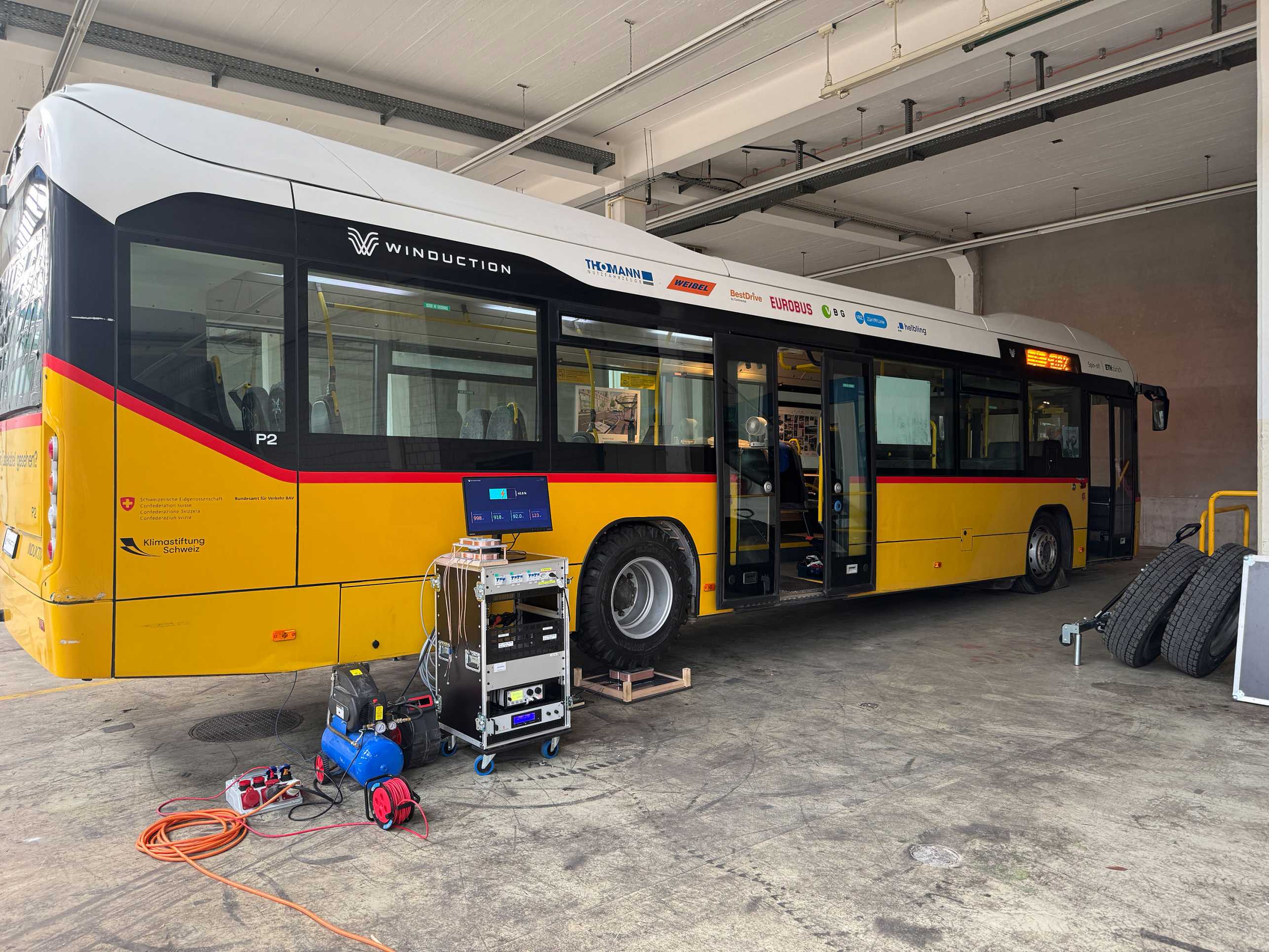
Winduction is building a test site in Winterthur, with a lab and its own bus stop. The Federal Office of Transport and the Swiss Climate Foundation back that work. Its first test vehicle is an electric post bus.
The first pilot is due in 2028 near Zurich Airport. That bus will be the first to carry passengers. The firm is also in talks with several Swiss bus firms.
Schwitter thinks electric buses “can be operated much more cheaply if they are charged wirelessly and regularly”. Before then, the next step is a fully converted bus that can run outside the private test area. If the pilot works, wireless bus charging could give bus firms a new way to go electric without huge batteries.