Researchers at ETH Zurich say one cheap reagent breaks acrylic glass into its building block at just over 200C, recovering up to 98 per cent.
Chemists at ETH Zurich have found a way to make acrylic glass recycling work at far lower temperatures than existing methods. The university announced the results on 19 October, and the team has published its paper in Nature Chemistry. ETH says the process could make recycling the material economically viable.
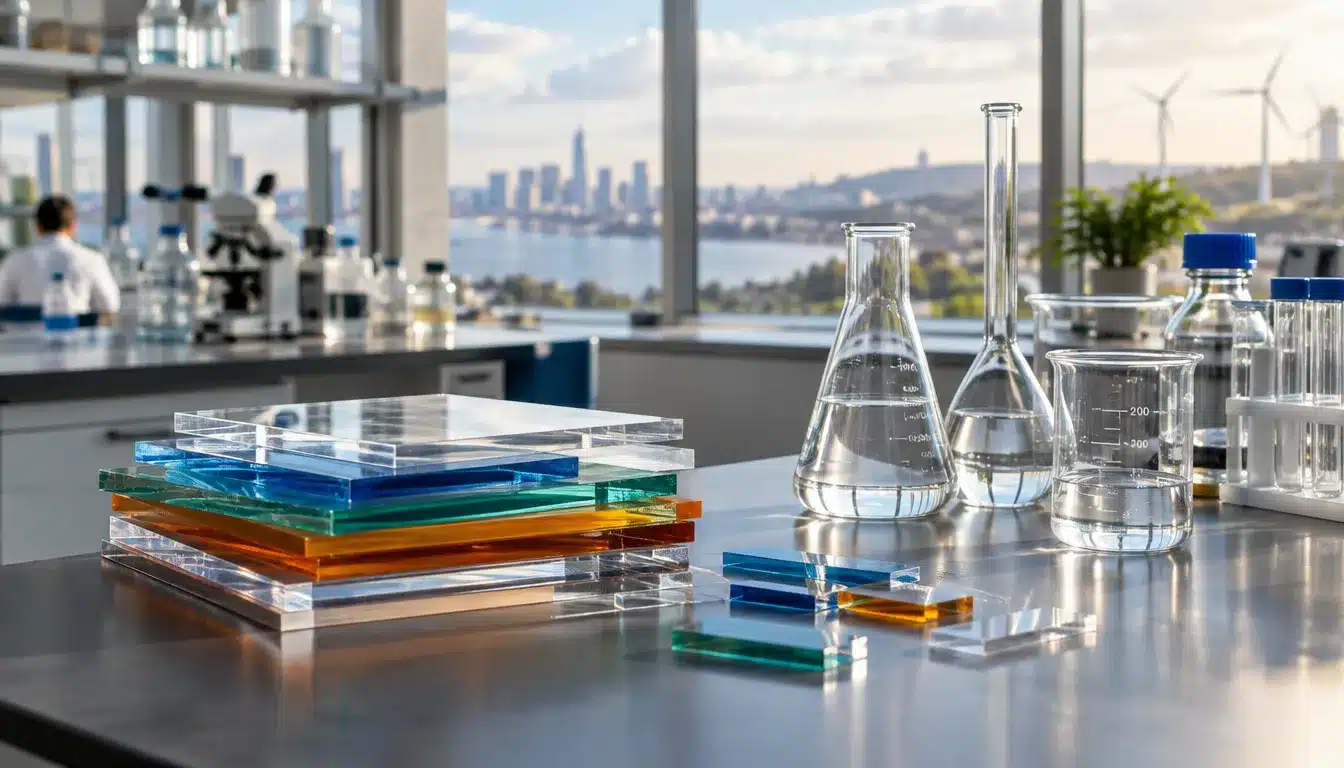
Acrylic glass, sold under brand names such as Plexiglas, turns up in window panes, car tail lights and furniture. Chemists call it polymethyl methacrylate, or PMMA. Like most plastics, it’s a long chain of small units called monomers. To recycle it chemically, you have to break that chain apart and collect the units.
One chemical and no solvent
The new process uses one cheap, off-the-shelf reagent from a class of compounds called N-hydroxyimides. It needs no solvent at all. Once heated to just over 200C, the plastic starts to unzip into its monomer, which the team can collect and reuse.
Earlier methods needed at least 400C to get the same reaction going. So the ETH approach roughly halves the temperature needed. In tests, the yield of recovered monomer reached as high as 98 per cent.
“What makes our new approach so exciting is its simplicity,” said Richard Whitfield, the paper’s lead author and a former research associate in the group. Athina Anastasaki, a materials scientist and professor at ETH Zurich, leads the group.
Why purity decides reuse
Purity is the main test for acrylic glass recycling, as for any recycled feedstock. Pyrolysis, a common chemical recycling method for this plastic, usually runs above 400C. It returns monomer with impurity levels of up to 3 per cent, according to ETH. In turn, those impurities can lower the quality of any new plastic made from the recovered material.
By contrast, the ETH team reports that its monomer comes out very pure. That held even when the starting material contained dyes or other impurities. As a result, the researchers say the recovered monomer can make new acrylic glass of the same quality as the first time round.
That’s the key commercial point. Mechanically recycled plastic often ends up in lower-grade products because each pass degrades it. However, a process that returns clean monomer can, in principle, feed the same product again and again.
A search for the right reagent
Anastasaki’s group hunted for the right reagent before it settled on this one. “We searched systematically until we found this substance,” she said. Still, the outcome caught the team off guard. “The only thing that surprised us was that a single chemical really was sufficient for the reaction,” she added.
ETH links this simplicity to its case for economic viability. The process has one reagent and no solvent, so there’s less to buy, handle and separate afterwards. It also runs at about half the heat of older routes.
ETH also sets out the limits. The method works only on acrylic glass, according to the university. Other plastics will need their own chemistry, so the process won’t help with mixed plastic waste on its own.
From the lab to licensees
So far the work is at lab scale, and ETH gives no date for a pilot plant. The university has filed a patent application and is now looking for industrial licensees.
Next, the team plans to scale up the method and study how the reaction works in more detail. After that, it wants to develop additives that speed up the breakdown and push yields higher. The researchers also plan to test the same principle on polystyrene, another widely used plastic.
Anastasaki expects a crowded field. “Competition in chemical plastics recycling is fierce,” she said. Other research groups and companies are also developing chemical recycling technology for plastics.
For now, the ETH result shows what acrylic glass recycling could look like with less heat and fewer inputs. The next test is a licensee willing to take it beyond the lab. Until then, its costs at scale remain unproven.