
Patrick Peters, CEO and Co-Founder of Spark Cleantech, explains how pulsed plasma can strip carbon from natural gas before it reaches an industrial burner, and why he believes the economics can work without heavy subsidy.
Heavy industry produces roughly a fifth of global CO₂ emissions, yet most of Europe’s hydrogen policy has been written with electrolysis in mind. Paris-based Spark Cleantech, founded in 2022 within the laboratories of CentraleSupélec, is pursuing a different route. Its reactor sits between a factory’s gas supply and its burners, where it splits methane into hydrogen and solid carbon without combustion. The company raised €30 million in Series A funding in December 2025 and is targeting its first commercial units in 2027. Climate Solutions News put ten questions to Patrick Peters about the technology, the carbon product, the regulatory gap and the investment case.
Methane plasmalysis has existed in various forms for decades. What has historically prevented it from reaching industrial scale, and what has Spark Cleantech resolved that predecessors could not?
Methane plasmalysis faced three barriers to industrial scale: high energy costs, inconsistent carbon quality, and reactor durability issues. Early systems were energy-intensive, produced low-value carbon, and suffered from electrode degradation and fouling.
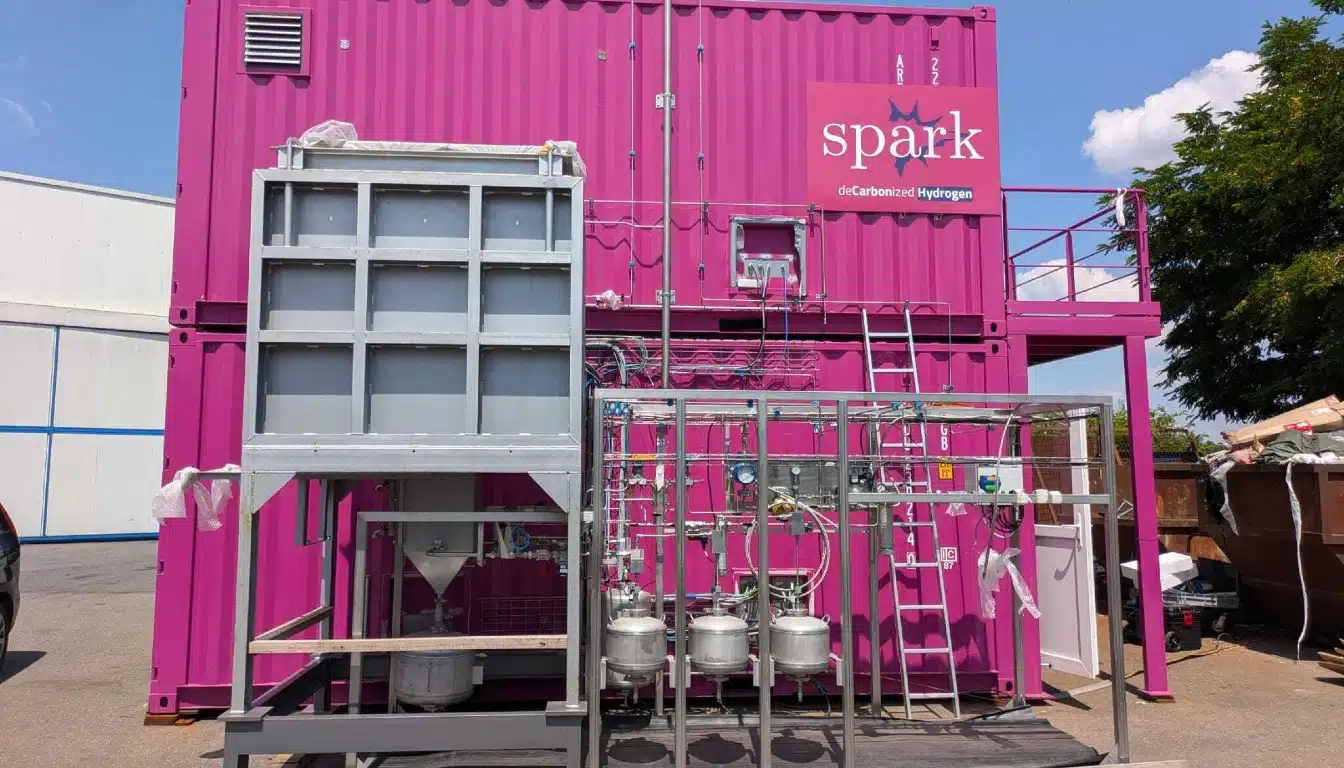
Our proprietary non-thermal plasma reactor cuts energy use to 20% of water electrolysis, produces high-purity carbon black for premium applications, and uses fouling-resistant materials for long-term stability.
You claim five times less electricity consumption than water electrolysis. Under what operating conditions does that hold, and how does it change if a client is running on grid power rather than renewables?
The five times lower electricity consumption is a fixed technical advantage of our reactor, independent of the power source. CO₂ emissions from the electricity used to power the reactor, not the reactor itself, depend solely on how that electricity is generated. On a clean grid, both energy and emissions benefits are maximised. On a fossil-based grid, the energy efficiency remains, but the emissions tied to the electricity source persist.
Patrick Peters, CEO and Co-Founder of Spark Cleantech
Solid carbon is central to your economics, but the carbon black market is mature and dominated by established producers. How are you qualifying your material for demanding end-uses such as battery manufacturing, and what price premium, if any, are buyers currently willing to pay?
Our energy efficiency and low CO₂ emissions give us a competitive edge over traditional furnace blacks, especially under strict EU regulations. We’re already engaging with a potential customer who has a specific need for carbon black and is interested in our product. This positions us well to qualify for demanding end-uses like battery manufacturing, where sustainability and performance are critical.
Your technology sits between a client’s existing gas network and their burners. In practice, how resistant have industrial operators been to modifying infrastructure they have run the same way for decades?
Industrial manufacturers are highly motivated by the high energy efficiency our technology provides. Many players need to use both natural gas and hydrogen in their processes to mitigate carbon emissions. We are starting a project with a major industrial partner in this space, demonstrating real-world readiness to adapt infrastructure for these benefits.
You describe a zero or even negative carbon footprint when using biomethane as the feedstock. How available is biomethane at the volumes and price points your model requires, and what happens to the carbon accounting if a client stays on fossil gas?
Biomethane is currently three to four times more expensive than fossil methane, but its market is expanding, and state incentives help offset costs while encouraging adoption and future price reductions.
It enables a zero or negative carbon footprint for our process. If a client uses fossil gas, emissions remain positive, though still lower than traditional methods, allowing a smooth transition to biomethane as availability improves.
You have signed initial contracts and are targeting 2027 for commercial unit deployment. What are the two or three variables most likely to push that date, and how are you managing them?
We’re targeting 2027 for commercial deployment, with initial contracts signed. The main variables that could impact the timeline are permitting and regulation, supply chain, and client site readiness.
On permitting and regulation, hydrogen projects face lengthy approvals, especially in Europe. We’re engaging early with regulators to align with frameworks like RED III and CBAM. On supply chain, critical components such as electrodes and plasma generators have long lead times. We’ve secured multi-year agreements and backup suppliers. On client site readiness, delays in gas supply, electrical infrastructure, or offtake agreements can stall progress. We use milestone-based payments to incentivise clients to stay on schedule.
You describe hydrogen as a service, producing and operating on-site rather than selling equipment. What persuaded you that model was preferable to a direct capital equipment sale, and what are its risks for Spark as you scale?
We chose Hydrogen-as-a-Service (HaaS) over equipment sales for three reasons. The first is a lower barrier to entry: clients avoid upfront risk, and we assume technical and performance responsibility. The second is recurring revenue: long-term offtake agreements provide stable cash flow, appealing to investors. The third is continuous optimisation: on-site operation lets us refine efficiency and carbon quality using real-world data.
There are risks for Spark. CapEx strain from high upfront costs is managed via project financing and partnerships. Operational liability from performance guarantees is mitigated with redundancy and strict maintenance. Scaling complexity from distributed operations is streamlined through remote monitoring and automation.
Much of the EU’s hydrogen policy framework has been built around electrolytic green hydrogen. Does the regulatory environment actively support methane-based pathways such as yours, or are you working around a framework that was not designed with you in mind?
The EU’s hydrogen policy framework, including the Renewable Energy Directive (RED III) and the Hydrogen Delegated Acts, was primarily designed for electrolytic green hydrogen. Methane-based pathways like ours don’t fit neatly into the current definitions, which focus on renewable electricity inputs. However, there are two encouraging developments.
The first is biomethane-based hydrogen. The EU recognises biomethane as a renewable fuel, so our process using biomethane qualifies as “renewable hydrogen” under RED III. The second is carbon capture and storage. For fossil gas feedstocks, the EU is evolving its stance on hydrogen with CCS. Our solid carbon byproduct, which can be permanently stored, may soon be recognised as a valid carbon mitigation strategy, though the regulatory pathway is still unclear.
We’re actively engaging with policymakers and standards bodies such as CEN and the IEA Hydrogen TCP to ensure methane plasmalysis is fairly represented in future regulations. In the meantime, we’re using existing frameworks such as ISCC certification for biomethane to validate our carbon footprint.
Heavy industry accounts for roughly a fifth of global CO₂ emissions, yet it remains the sector where decarbonisation progress is slowest. Why, in your view, has the field attracted comparatively less investment and policy attention than power generation or transport to date?
Heavy industry’s slow decarbonisation stems from three structural challenges. The first is high energy demand. Industries like steel, cement, and glass require extreme heat of 1,000 to 2,000°C, which is hard to achieve with renewable electricity or green hydrogen at scale. The second is economic incentives. Unlike power generation, where renewables are now cost-competitive, or transport, where EVs benefit from subsidies, industrial decarbonisation lacks strong policy support. Carbon prices such as the EU ETS at around €80 per tonne are not yet high enough to justify switching from fossil fuels. The third is technological maturity. Many low-carbon solutions, such as green steel via hydrogen DRI and carbon capture for cement, are still in pilot phase, with high CapEx and unproven reliability.
Investment has lagged because the risk-reward ratio is unfavourable. Industrial players face high upfront costs with uncertain returns in a volatile policy environment. At Spark Cleantech, we’re addressing this by focusing on drop-in solutions, such as replacing fossil gas with hydrogen in existing burners, that require minimal infrastructure changes and offer immediate emissions reductions.
You have clearly been successful at raising funds to date. Investors and analysts hear a great many industrial decarbonisation pitches. What do you think sets you apart in terms of potential returns over other solutions?
Investors hear countless decarbonisation pitches, but Spark Cleantech stands out for three reasons. The first is dual revenue streams. Unlike pure hydrogen plays, we monetise both hydrogen and carbon black, diversifying revenue and improving margins. Our carbon product is not a waste stream, it’s a high-value co-product with growing demand in batteries and tyres. The second is energy efficiency. Our five times lower electricity consumption versus electrolysis translates to lower operational costs, especially in regions with expensive power. This makes our hydrogen cost-competitive even without heavy subsidies. The third is scalability and flexibility. Our modular reactors can be deployed on-site at industrial facilities, avoiding the transport and storage challenges of centralised hydrogen production. This reduces infrastructure costs and accelerates adoption.
In addition, our HaaS model aligns incentives. Clients pay for hydrogen output, not equipment, reducing their risk while ensuring recurring revenue for us. With first commercial units targeted for 2027 and a pipeline of LOIs with major industrials, we’re positioned to capture early-mover advantage in a market poised for explosive growth.