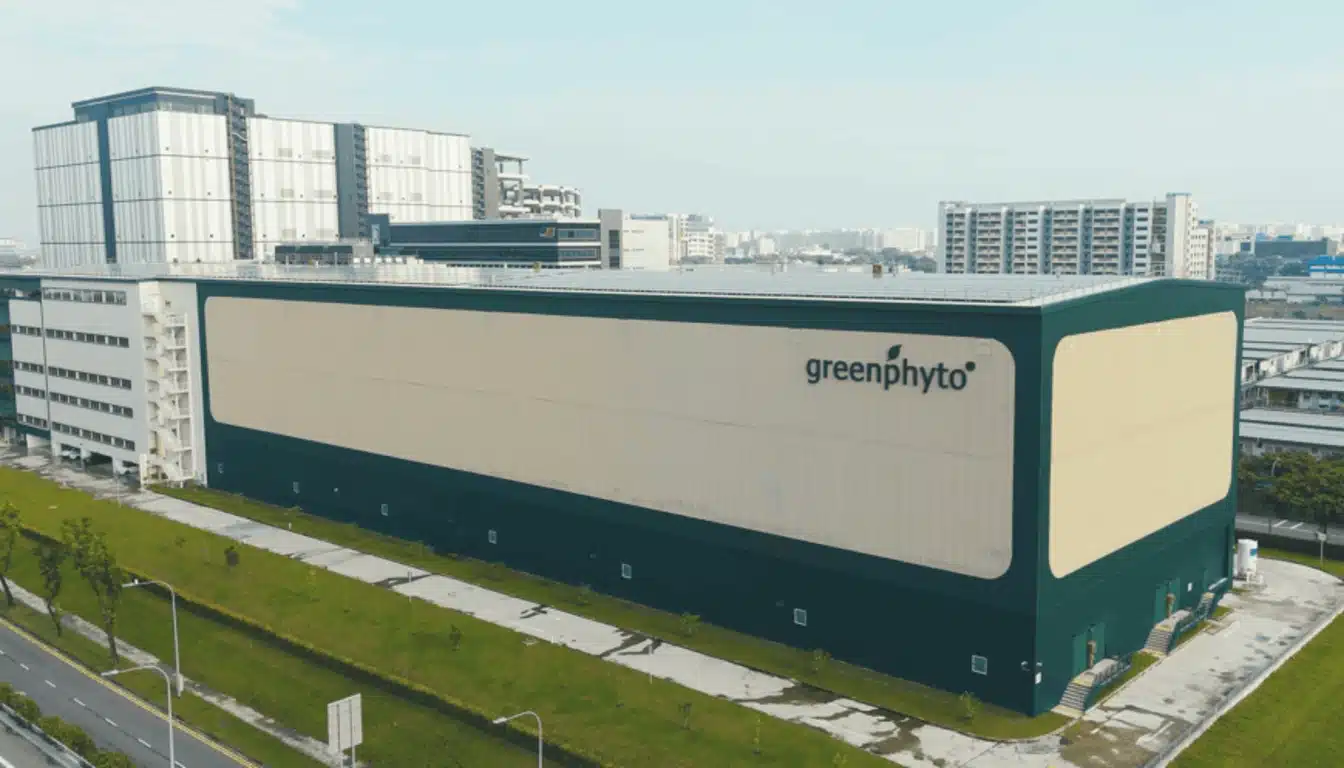
Greenphyto’s €80 million, five-storey indoor farm in Jurong West, Singapore, equipped with AI and automation, aims to revolutionise sustainable urban food production amidst industry turbulence and high costs.
Gleaming hydroponic towers rising more than 23 metres now punctuate the industrial skyline of Jurong West, after the official opening in January of what its developer calls the world’s tallest indoor vertical farm.
Greenphyto’s five‑storey, S$80 million complex occupies about 2 hectares and houses five unmanned growing chambers, each with twin 118‑metre long, 23.3‑metre high towers stacked with more than 500 racks. The facility is fully automated, powered by artificial intelligence and manufacturing bots, and at full capacity is capable of producing about 2,000 tonnes of leafy greens a year; current production is roughly 200 tonnes. President Tharman Shanmugaratnam attended the launch, the report said.
Greenphyto’s founder, Susan Chong, told The Straits Times that the project is the culmination of a 14‑year vision. “(The farm closures) made me more determined to make it happen and do it differently, and learn from the issues faced by other farms on what is not working, and to make sure that we are well covered,” she said. She added that technology must serve the end product: “Farms in the US, for example, are very focused on the tech. At the end of the day, your produce is your product. If you don’t have good‑quality produce, what good is your tech?”
Retail shoppers may already have encountered Greenphyto’s output: the company sells kailan and several varieties of lettuce under the Hydrogreens brand and, since early 2025, its produce has been stocked in about 95 stores including FairPrice, Sheng Siong and Japanese supermarket chain Meidi‑Ya, according to multiple reports. A 200g pack of kailan was reported at $3.95 and a 100g pack of leaf lettuce at $3.20.
The farm blends several revenue streams. In addition to retail sales, Greenphyto is marketing its novel growing system internationally through offices in Malaysia and the Netherlands, and plans to monetise the farm’s so‑called nervous system , an AI platform that monitors crop health, germination rates and yield predictions , as a service. The company is planning a technology spin‑off, Arber.ai, to provide consultancy and digital adoption services for other farms and SMEs, Greenphyto said.
Greenphyto emphasises innovation and efficiency. The firm holds 69 patents related to crop optimisation and cost reduction, and has cut its energy use by about 30 per cent through research and vendor collaboration. One measure involved bespoke LED lighting that can be adjusted by crop and growth stage, rather than illuminating all racks uniformly. The farm also operates on a make‑to‑order basis to reduce waste, fulfilling orders only after retailers have committed purchases, the reports said.
Automation handles most tasks inside the chambers; only harvesting requires human labour to ensure neat packaging. A purple, crane‑like robot runs between twin towers to place seedling trays and monitor crops, while daily e‑mail alerts from the AI platform flag issues such as yellowing leaves and suggest possible root causes, according to Greenphyto’s chief digital officer, Liow Wei Quan. The farm’s AI work received support from the Infocomm Media Development Authority’s Digital Leaders Programme, which helped the company hire data engineers and software developers, The Straits Times reported. The Singapore Food Agency’s Agri‑food Cluster Transformation Fund has also backed the project.
The launch took place against a backdrop of turbulence in the vertical‑farming sector in Singapore. Industry coverage and local reporting note several high‑profile difficulties for tech‑heavy indoor farms over recent years, including closures, abandoned projects and investor caution. The Straits Times and other outlets cited examples such as Growy Singapore entering liquidation, VertiVegies shelving plans, and I.F.F.I shutting a large facility. Analysts and operators have pointed to high capital and energy costs, pandemic supply‑chain shocks and waning investor appetite as contributing factors. Singapore’s government also revised its earlier “30 by 30” target for domestic food self‑sufficiency, replacing it with new goals focused on fibre and protein production by 2035, which has changed the policy backdrop for local vegetable producers.
Greenphyto says it has sought to learn from those industry setbacks. The company stresses that combining agronomy with adaptable technology, close retail partnerships and multiple commercial avenues , equipment sales and AI services as well as fresh produce , will underpin its business model. Industry comment recorded by Business Times and specialist outlets emphasises that balancing technological sophistication with cost discipline and product quality is critical for indoor farms to achieve sustainable margins.
As Greenphyto scales, its ability to convert patented innovations and AI insights into repeatable revenue outside its own site will be watched closely by investors and peers. The farm’s opening, and its claim to being the world’s tallest indoor vertical operation, represents both a concrete example of advanced urban farming and a test case for whether high‑tech indoor agriculture can overcome the financial and operational hurdles that have challenged the sector.