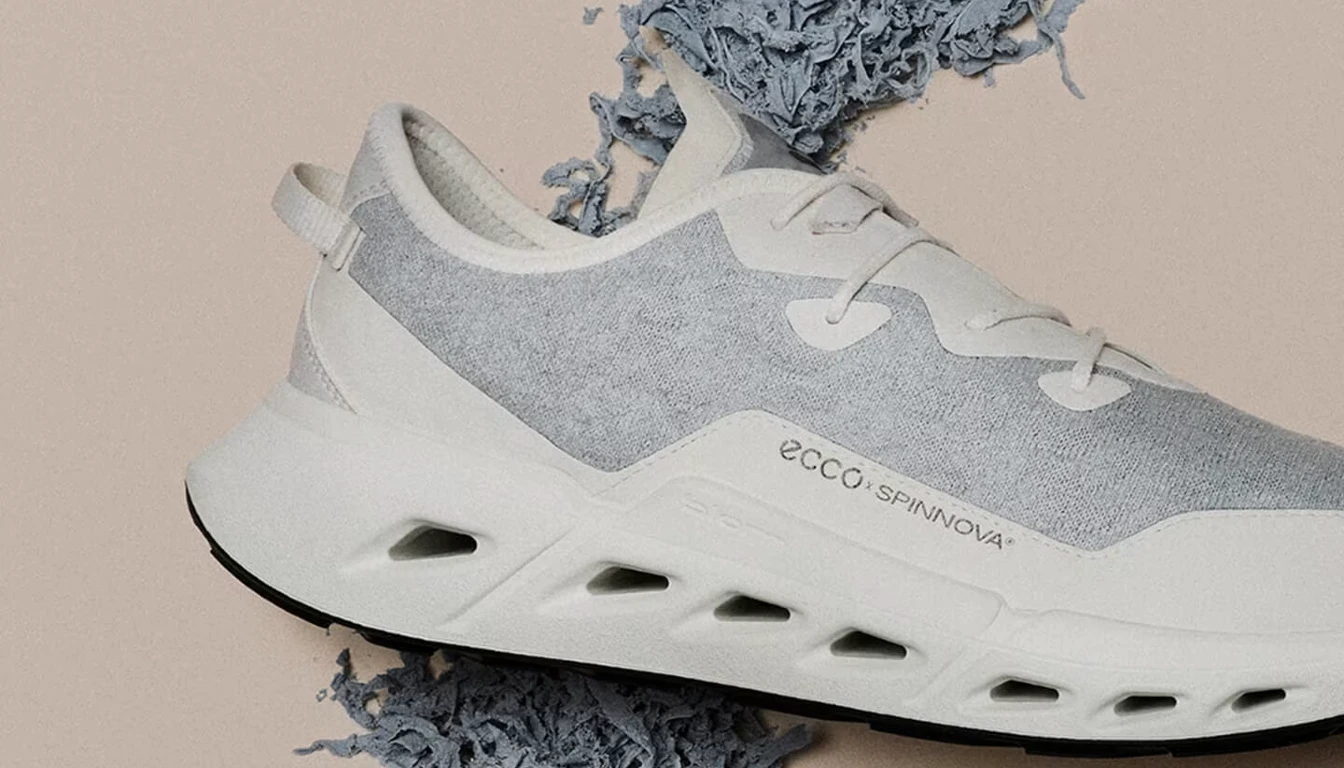
ECCO has put a leather-waste derived fibre into commercial use for the first time. The material appears in a limited-edition shoe, the BIOM 720, released at the end of April. The product is the result of a years-long collaboration with Finnish materials company Spinnova.
Together, the two companies have developed a protein-based fibre from tannery side streams.
How the Fibre Is Made
The raw material is wet blue shavings. These are thin leather trimmings removed during the production process. Spinnova refines them mechanically into continuous filaments. Those filaments are then cut for textile use. The company says the process avoids chemical dissolution entirely. It relies on mechanical treatment to preserve the natural qualities of the raw material.
The resulting fibre has tensile strength similar to wool. It stretches to roughly twice the level of cotton before breaking. That performance profile makes it suitable for both woven and knitted structures. These are technically useful properties for a fibre derived from what would otherwise be a production residual.
ECCO and Spinnova established a joint venture in 2020. The goal was to develop ways to upcycle leather residuals at scale. Spinnova later completed a pilot production line at its facilities in Jyväskylä, Finland. That line was designed to produce enough material for research, demonstration products, and early commercial testing. ECCO’s leather partner, KT Trading, was involved in the pilot-scale work.
What the Companies Are Claiming
Thomas Gøgsig, chief executive of ECCO, said the project showed how new materials could extract value from existing resources. Janne Poranen, chief executive of Spinnova, called the shoe a practical proof that leather by-products can become a commercially relevant textile fibre. Both statements are consistent with the commercial release, though neither company has published third-party verification of the environmental claims.
The claim that the process avoids chemical dissolution comes from Spinnova directly. Climate Solutions News has seen no independent life-cycle analysis confirming the full environmental profile of the fibre. Readers should treat the environmental framing as company-stated rather than verified at this stage.
The BIOM 720 went on sale at the end of April through ECCO’s website and selected stores in the United Kingdom and Germany. It is a limited edition. ECCO has given no public indication of production volumes or plans to scale the material into its wider range.
The Broader Context for Circular Footwear
The footwear sector faces sustained pressure to cut emissions and reduce dependence on virgin material inputs. Leather production carries a significant environmental footprint. Tanneries generate large volumes of solid waste, including the wet blue shavings at the centre of this project. Finding commercial uses for those residuals is a practical industrial challenge.
Several brands have explored bio-based and waste-derived materials in recent years. Progress has often stalled between pilot and commercial scale. The BIOM 720 is one of the first products to bring a leather-waste fibre to retail sale, even in limited quantities. That is a meaningful distinction in a space where many material projects remain at the demonstration stage.
The shoe does raise questions the companies have yet to answer publicly. End-of-life treatment for a blended fibre material is rarely straightforward. A shoe combining leather-waste fibre with other materials presents recycling challenges that circular design frameworks do not automatically resolve. ECCO has made no public statement on take-back or end-of-life protocols for the BIOM 720.
What Comes Next
The Jyväskylä pilot line was designed for early commercial testing rather than mass production. Spinnova has acknowledged this. Any significant scaling of the material would require additional investment in production capacity. Whether ECCO or Spinnova has committed to that investment is unclear from available public information.
For investors watching the materials transition in fashion and footwear, the release shows that at least one pathway from leather waste to commercial fibre is technically viable. The economics of that pathway at scale remain unconfirmed. Spinnova is a publicly listed company on the Nasdaq First North Growth Market in Helsinki. Its filings would be the appropriate source for financial detail on the venture’s progress.
The BIOM 720 is a small product release. Its significance lies in what it demonstrates about the technical feasibility of the approach, not in its volume.