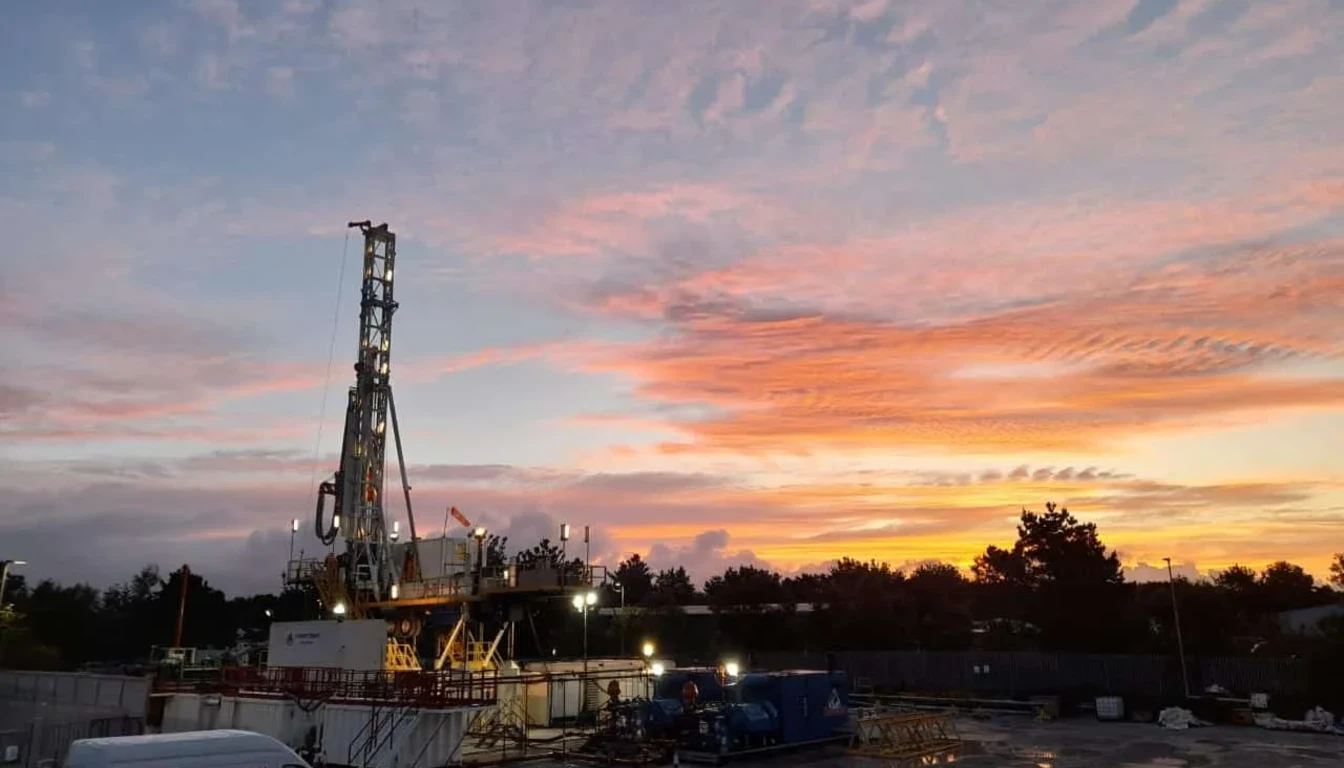
Picture from GEL Energy.
The United Downs project marks a double milestone for British energy: the country’s first commercial geothermal electricity and its first domestic zero-carbon lithium supply.
After decades of ambition and years of drilling into Cornwall’s ancient granite, the United Kingdom has its first operating deep geothermal power station. Geothermal Energy Lithium (GEL) confirmed on Thursday that its United Downs plant, located on an industrial estate near Redruth, is generating electricity around the clock and supplying power to the grid via a deal with Octopus Energy.
The plant has a generating capacity of 3 megawatts, enough to supply approximately 10,000 homes. That is a modest figure by the standards of wind or solar, but geothermal’s defining quality is consistency: unlike wind and solar, it produces power continuously regardless of weather or season. GEL describes the output as true baseload renewable power, filling a gap that Britain’s grid has so far struggled to address without fossil fuels or nuclear.
Dr Ryan Law, CEO of GEL, said the launch represented “a landmark step for the UK, generating electricity and lithium by harnessing the resources beneath our feet.” Greg Jackson, founder of Octopus Energy, framed the significance in consumer terms: “Bills are still too high, and the answer is more homegrown, renewable energy. For the first time, we’re bringing deep geothermal power to British homes — a clean, constant energy source right beneath our feet.”
The project has been a long time coming. GEL drilled the two wells at United Downs between November 2018 and June 2019, according to project records published by Wikipedia’s entry on the site. The production well reached a depth of 5,275 metres, making it the deepest well drilled on UK soil. The underlying geology is key: the Cornubian granite batholith, which stretches from Dartmoor to the Isles of Scilly, contains high concentrations of heat-producing isotopes, giving United Downs a geothermal gradient almost 10°C per kilometre hotter than the UK average.
The electricity story is only half of Thursday’s announcement. GEL simultaneously disclosed that it expects to begin producing up to 100 tonnes of zero-carbon lithium carbonate annually from February 2026, positioning the site as one of Europe’s larger producers. The geothermal brine extracted from the production well contains around 340 parts per million of lithium, among the highest concentrations recorded at any commercial geothermal project in Europe, according to third-party testing cited in earlier GEL announcements.
Ministers were quick to flag the strategic implications. Chancellor Rachel Reeves described the project as “a huge opportunity for Cornwall to unlock investment, drive economic growth, support jobs, and establish the region as a vital player in Britain’s energy security.” Dr Alan Whitehead, Minister of State for Energy Security and Net Zero, pointed to the supply chain dimension: “With zero-carbon lithium now being produced here in the UK, British businesses are leading the way in securing the materials needed to power the next generation of electric cars.”
The domestic lithium angle addresses a vulnerability that has grown more pressing as electric vehicle targets tighten. The UK currently relies heavily on lithium refined in China. GEL has said it plans to scale production to 1,000 tonnes per year from United Downs alone by 2026, and to more than 12,000 tonnes annually across its UK portfolio by 2030, sufficient to supply batteries for around 250,000 electric vehicles per year.
Jason Cheng, CEO of Kerogen-CX, one of GEL’s backers, described the launch as “a major milestone for UK geothermal and a strong validation of our investment strategy.” He added that Kerogen believes “the sector is at an inflection point and are committed to scaling it across the UK and Europe.”
The wider potential is substantial. Analysis by Project InnerSpace, published in April 2025, estimated that the UK could cost-effectively meet nearly a third of its current electricity demand from geothermal resources, alongside a significant share of its heating needs. The UK National Geothermal Centre, launched in June 2024, has projected that 50,000 jobs could be created if the sector scales as expected.
United Downs is a proof of concept as much as a power station. Whether it triggers a broader buildout will depend on the policy framework, grid connection capacity, and the pace at which investors gain confidence in a technology that the UK has long talked about but never commercially deployed. Thursday’s switch-on at least removes one uncertainty: geothermal power in Britain works.