

The global green economy has passed $5 trillion a year and is expected to exceed $7 trillion by 2030, according to new analysis from the World Economic Forum and the Boston Consulting Group. The authors describe a sector that is expanding at remarkable speed, second only to technology, and delivering consistent financial advantages for companies that move early.
The report, Already a Multi-Trillion-Dollar Market: A CEO Guide to Growth in the Green Economy, shows that momentum has held despite geopolitical, regulatory and cost pressures. The authors state that “the green economy surpassed $5 trillion in value last year. By 2030 it is projected to grow to over $7 trillion, despite a diverging global environment”.
Which Markets Are Driving Growth?
The report attributes the expansion to rapid technology cost declines, record investment and the spread of national net-zero frameworks. Mitigation continues to dominate total revenue.
Transportation and mobility represent the largest share.
Adaptation and resilience now contribute more than one fifth of the market. The authors note that “mitigation has driven the majority (78%) of this value to date” and that adaptation is “driven primarily by climate-adapted agri-inputs, resilient construction materials and cooling technologies” .
The cost of major technologies has dropped sharply. Solar photovoltaics and lithium batteries have fallen by around 90 percent since 2010 and offshore wind by around 50 percent. As a result, 55 percent of potential global emissions reductions can already be achieved with solutions that are cost competitive.
However, the report warns that progress is uneven. Low-carbon hydrogen and carbon capture, utilisation and storage remain expensive. The authors explain that “more immature and costly technologies such as low-carbon hydrogen and carbon capture, utilization and storage (CCUS) may not [grow], as they still require favourable and often much more local regulation”.
Pim Valdre, Head of Climate and Nature Economy at the Forum, stresses the scale of the shift. He says that “despite the current headwinds for global climate action, this report shows that the green economy is not a distant opportunity but already a major growth engine of this decade.” In the report foreword, he adds that “investments in green technologies keep jumping from record to record – the green economy now represents a multi-trillion-dollar market and is exceeded in growth rate only by the technology sector”.
China’s Expanding Leadership
One of the dominant findings in the analysis concerns China’s position in clean-energy manufacturing and deployment. The report states that China invested $659 billion in clean energy in 2024 and is responsible for more than 60 percent of new global renewable capacity additions through 2030. The authors say China is “consistently outspending, outproducing and out-deploying other countries”.
China’s lead in patents for solar, electric vehicles and batteries has reshaped global supply chains. The report suggests that innovation, scale and deployment are now moving eastwards at a pace that will influence competitive dynamics across every major green sector.
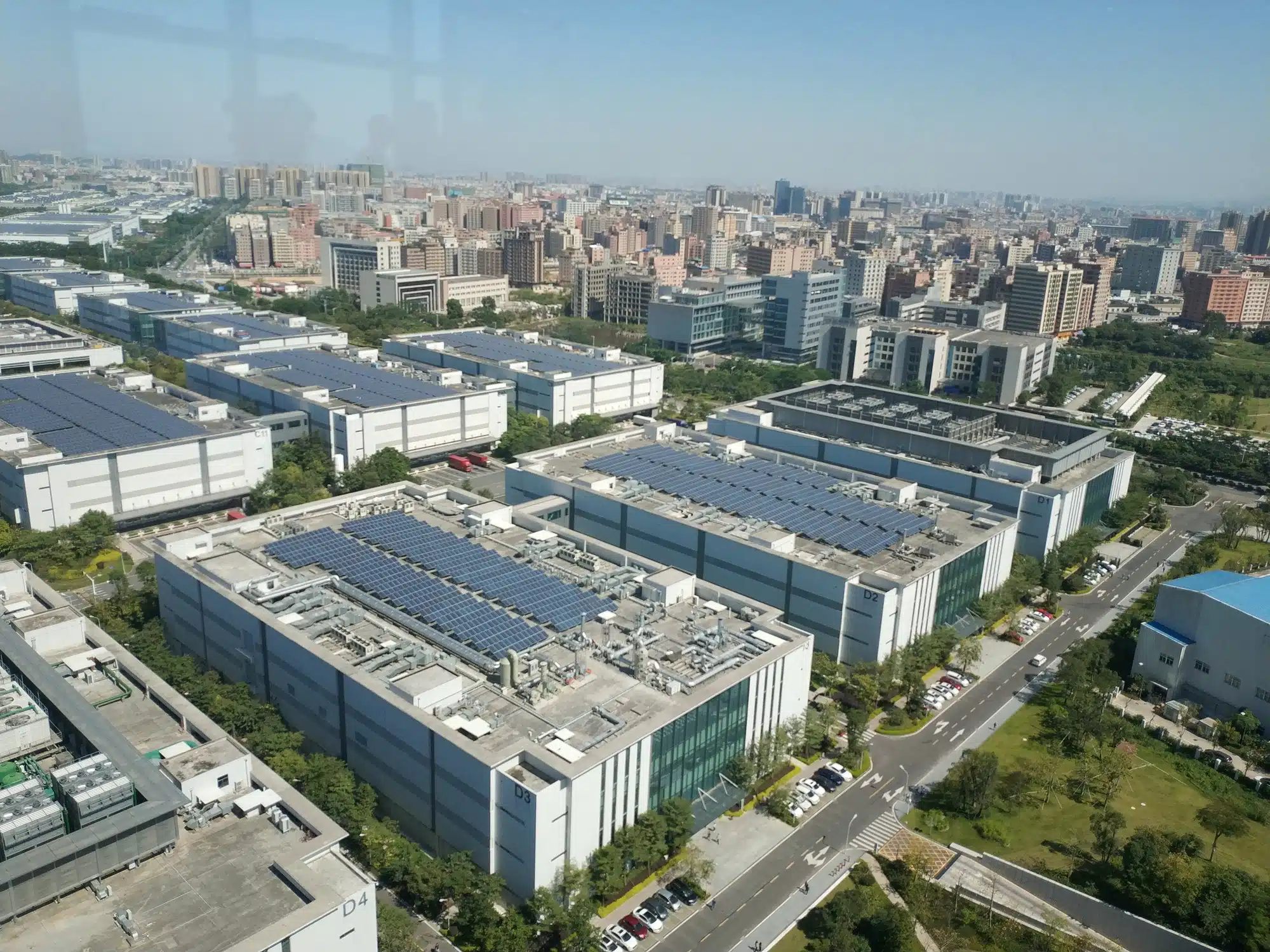
Tech city Shanghai, the Silicon Valley of China. Photo by Md Mintu Hossain on iStock.
Outperformance Across Financial Metrics
One of the clearest conclusions in the study is the financial outperformance of companies with growing green revenue streams. The authors state that “on average, green revenues grow two times faster than conventional business lines across the market.” They also find that companies with material shares of green revenue “typically get access to cheaper capital.” Their analysis shows that between 2020 and 2024, green revenues grew at 12 percent a year, “twice as fast as conventional business lines”.
Valuation data supports this trend. Companies earning more than half their revenue from green markets often achieve premiums of 12 to 15 percent. The broader performance data shows that the green economy has been “the second-best performing sector among Industry Classification Benchmark industries… during the past decade, second only to technology”.
These results reflect exposure to higher growth markets, reduced cost of capital and increased investor confidence in long-term resilience. The authors describe this as evidence that the financial case for climate-aligned business models has strengthened each year.
Patrick Herhold, Managing Director and Senior Partner at BCG, highlights three major trends. He says that “the resilience of the green economy… China’s leadership in manufacturing, innovation and deployment of green technologies; and the opportunity for companies operating in green markets to outperform and earn a premium in capital markets” stand out most.
Strategic Implications For Companies
The report argues that success in green markets depends on clear strategy, differentiated value propositions and agile operating models. It states that “green markets can be more difficult to navigate as they are often more nascent and rely on technologies that are still at the beginning of their maturity curve”.
Three accelerators define the most successful companies. They push new technologies to cost maturity, shape regulatory and market ecosystems and unlock diversified finance. Leaders also secure early demand, build resilient supply chains and set quantified ambitions that align with emerging standards.
The authors warn that delay carries rising risk. They state that “those who delay run a growing risk of falling behind as the market accelerates” and that “the green economy is no longer a distant promise: it is here, expanding fast and already creating trillions in value”.
Feike Sijbesma, Co-Chair of the Forum’s Alliance of CEO Climate Leaders, adds that “the green market is one of the greatest economic opportunities of our time. From clean energy to sustainable finance, it is driving new engines of growth”.
The report forecasts that the market will continue to grow across both mitigation and adaptation. Companies that act now will shape the next decade of industrial and economic development.