Climate Tech in 2025 is no longer a freewheeling frontier sector. It has entered what Net Zero Insights calls the execution era, shaped by higher expectations, sharper investment filters and growing pressure to reach commercial readiness. According to the organisation’s State of Climate Tech 2025 report, global funding is projected to hold above $52.9 billion for a third consecutive year, yet this headline stability masks deeper fragilities. Deal activity has fallen by about 30 percent, early stage investment has contracted to a five year low and many hard tech ventures remain stuck between promising prototypes and commercial viability.
The report captures this shift with unusual clarity. “2025 marks Climate Tech’s reckoning. The world needs deployment, not declarations. The question is no longer whether breakthrough technologies exist, but whether they can scale profitably and deliver on time.” It is a transition that defines both the resilience and the vulnerability of the sector.
In commentary accompanying the analysis, Sofia Esteves, Head of Market Insights at Net Zero Insights, highlights the growing pressure on young companies. “Pre seed and seed activity has fallen to a five year low, pointing to a more disciplined and selective early stage market. The retreat of grants, incubators and accelerators has reduced the number of ventures entering the pipeline, while cautious investors demand clearer paths to profitability early on.”
The picture is of a sector maturing on the surface while its foundations weaken.
A stable headline conceals a reshaped market
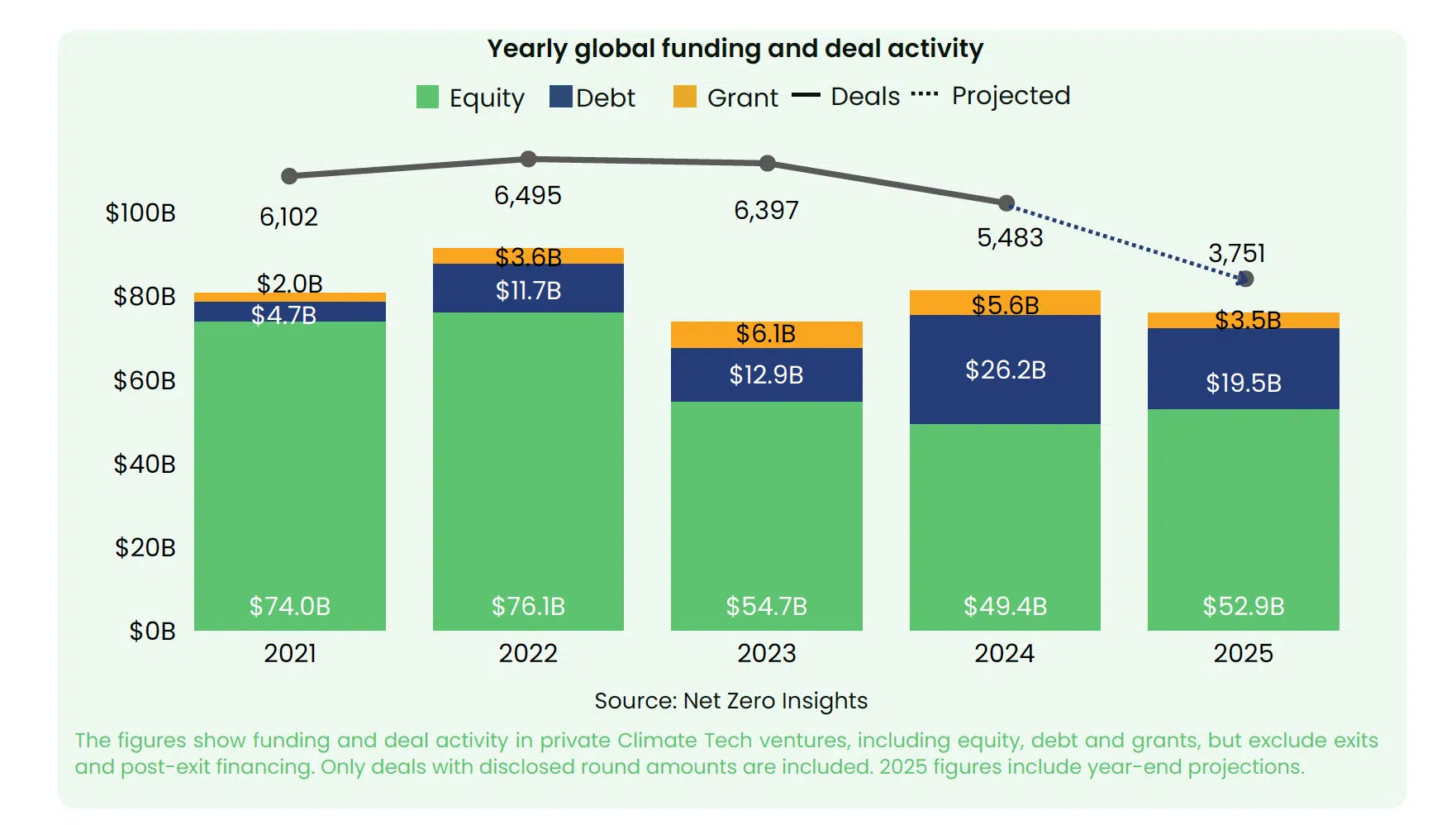
Global funding levels remain solid. Climate Tech deployed $54.7 billion in 2024 and is set to reach $52.9 billion in 2025. The sector appears steady on paper. Yet the report stresses these figures conceal a deeper shift:, because capital is concentrating in fewer companies with stronger commercial signals.
Deal volumes fell from 5,483 in 2024 to a projected 3,751 this year. The report describes this as “a decisive transition from the euphoria of 2020–2022 to an era defined by strategic selectivity.” While equity investment remains strong, the underlying innovation pipeline has weakened. Investors are prioritising ventures capable of meeting real demand, demonstrating manufacturing readiness, securing offtake and aligning with tightening policy frameworks.
“This is the year Climate Tech moves from aspiration to accountability. When promise becomes proof,” the report notes.
The sector appears steady on paper, yet the figures conceal a deeper shift.
The early stage engine falters
The most significant change in the 2025 landscape is the steep deterioration in company formation and early stage progression. Public grant funding has fallen 51 percent year on year. Incubators and accelerators have reduced their intake.
Governments are diverting capital from research into deployment. The combined effect is a marked thinning of the early stage pipeline.
Net Zero Insights warns that this is creating a “pre seed vacuum.” “Behind stable overall funding lies a quieter contraction. The actors that traditionally absorb early risk have stepped back. Public capital is shifting from idea formation toward infrastructure and deployment, leaving fewer ventures equipped to enter the pipeline.”
The impact shows clearly in graduation rates. For ventures founded in 2020 and 2021, the probability of progressing from Seed to Series A within three years often sat between 15 and 25 percent. For those founded in 2022 and 2023, that rate has halved to 5–12 percent. The situation is even more pronounced at later stages. “In 2025 nearly 50 percent fewer companies reached Seed to Series A, and 80 percent fewer made it from Series A to Series B compared to 2022, despite needing six extra months to progress.”
Esteves notes that this contraction threatens long term innovation. “The tightening is now flowing downstream. Fewer companies are making it through the system just as the need for commercially ready climate solutions intensifies.”
Many climate technologies require long development cycles in chemistry, materials, industrial processes and storage. Weakness at the earliest stages will narrow the pool of scale ready technologies later in the decade.
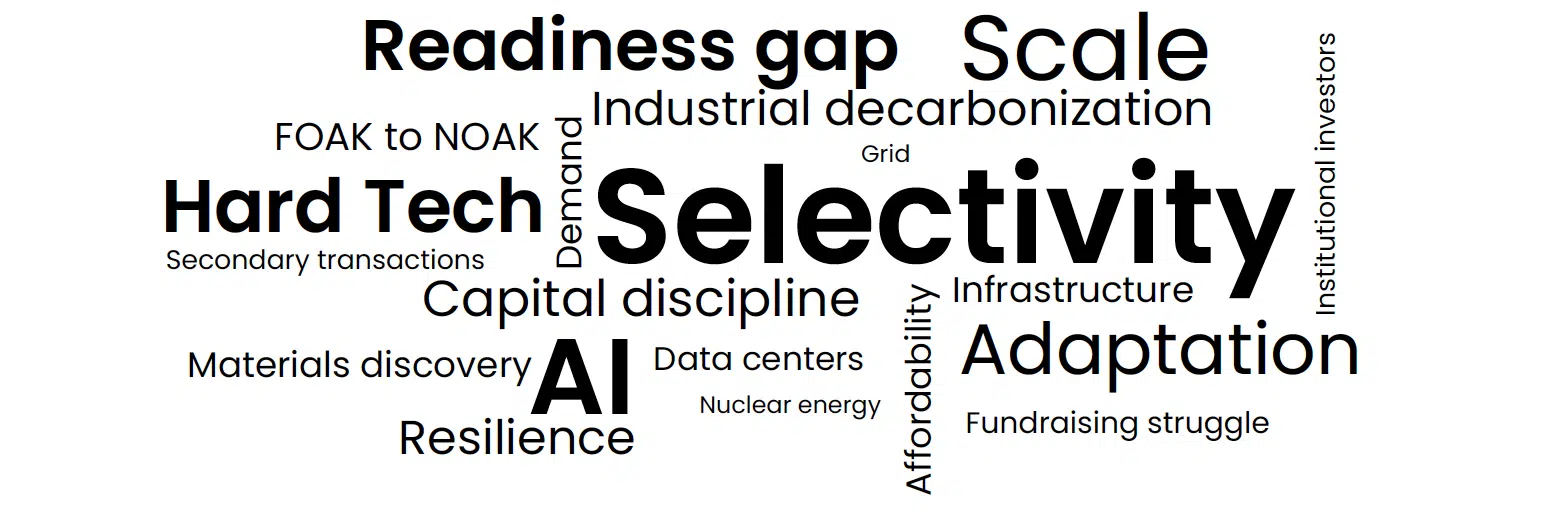
This word cloud from Net Zero Insights’ report clearly shows the key themes of 2025.
Capital concentrates around scale and affordability
As early stage investment contracts, late stage capital remains firm. Energy funding rose 5.5 percent year on year. Industrial decarbonisation increased 29.2 percent, driven by green steel, industrial heat, process optimisation and biofuels. Grid technologies expanded 48.8 percent. Solar funding rose 29.7 percent.
Battery and solar remain central pillars of investment, together with grid modernisation. These three segments account for 55 percent of energy transition funding. Batteries alone attract around $6 billion a year, fuelled by demand from mobility, storage and data centre operators.
Climate Tech is maturing; the next phase depends on which solutions can scale in real markets.
Net Zero Insights explains the dynamic. “Climate Tech funding is channelling towards progressively affordable renewable sources like solar to meet rising energy demand, including for AI.
This, in turn, is fuelling a demand for supporting storage and grid resilience technologies.”
Transport funding fell 5.5 percent as the electric vehicle market matures. Capital is shifting towards electrified logistics, heavy duty transport platforms and charging infrastructure.
Hard tech dominates funding but struggles to reach commercial scale
Hard tech companies account for more than half of global climate equity funding in 2024 and 2025. Yet their commercialisation prospects vary widely. Autonomous vehicles achieve a 42.1 percent TRL 9 success rate. Heating and cooling reach 32.1 percent. Specialty chemicals sit at 28.7 percent. Green hydrogen, by contrast, reaches just 13.2 percent, and electrofuels 9.2 percent.
Transition times are lengthening across all categories. Pilot to demonstration now takes close to four years. Demonstration to commercial readiness often exceeds seven. These timelines have stretched for four consecutive years.
Making matters worse, debt financing for first of a kind projects has fallen around 70 percent year on year. Equity investors must now shoulder a larger share of capital intensive scale up.
The report warns, “Hard Tech dominates, yet its ascent exposes a critical weakness. Demonstration stage ventures face extended timelines, steep capital requirements and mounting investor fatigue. Without clear proof of scalability and customer traction, many stall before reaching commercial readiness.”
Nuclear had a breakout year. Long term power purchase agreements signed by Google, Amazon and Meta to power data centres through the 2030s and 2040s demonstrated a decisive turn toward firm clean power. The report notes expanding bipartisan support for nuclear in the United States and renewed momentum across Europe.
Strategic investors have become central to the hard tech ecosystem. They now undertake 20 to 30 percent more hard tech dealmaking than traditional investors, and offtake agreements have increased 35 to 40 percent. By anchoring demand, validating unit economics and backing long cycle assets, strategic investors have become the strongest bridge between demonstration and commercial scale.
Adaptation rises as resilience becomes a core investment theme
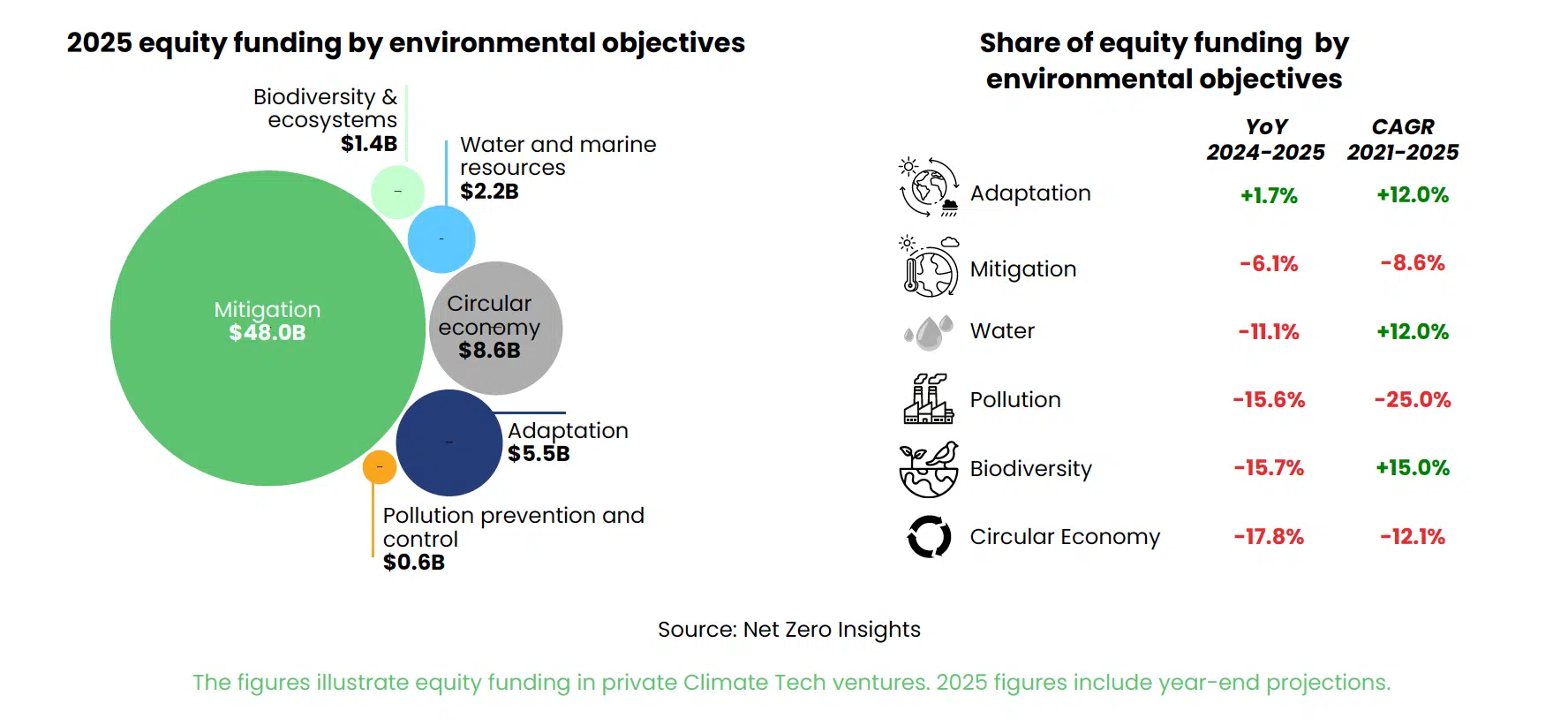
Adaptation emerged as the fastest growing investment category in 2025, with its share of equity funding jumping from 5.0 to 8.2 percent year on year—a 64 percent increase. Its share of equity funding rose from 5.0 to 8.2 percent year on year, a 64 percent increase. Investment in wildfire management grew 20 percent. Drought management rose 25 percent. The shift reflects rising climate volatility and the growing recognition that adaptation and resilience must complement mitigation efforts.
Adaptation technologies now sit alongside energy and industrial decarbonisation as a structural pillar of climate investment, supported by rapid advances in climate risk intelligence, water optimisation and precision agriculture.
AI reshapes the hierarchy of climate investment
AI has become the defining force in Climate Tech. “AI powers one in four climate equity investment dollars and determine which technologies move fastest,” the report states. AI enabled solutions captured 27.7 percent of all climate equity funding in 2025.
AI is driving growth across three fronts: the rise of energy intensive data centres; the acceleration of materials discovery, battery optimisation and solar forecasting; and new high resolution modelling in climate risk analytics, biodiversity and water systems.
“AI becomes Climate Tech’s new growth engine. AI is no longer a tool. It has become the infrastructure layer accelerating scale and reordering sector hierarchies,” the authors write.
AI categories also show resilience. Data centre funding rose 25.5 percent. Smart manufacturing expanded 197.8 percent. Grid infrastructure grew 30 percent.
Secondary transactions emerge as an alternative route for early investors
The report includes a detailed case study on Disa Technologies, showing how secondary transactions are becoming a viable exit route for early investors in hard tech. By allowing early shareholders to sell part of their stake to strategic or long horizon buyers, these transactions stabilise cap tables and help ventures progress toward capital intensive deployment stages.
Regional divergences widen
Regional differences are widening. “Geography accentuates these divides,” the report notes.
The United States leads in deployment, manufacturing and late stage capital. It dominates global hard tech funding and excels in nuclear, advanced materials, robotics and software integrated systems.
Europe faces a deepening capital shortage. Hard tech funding collapsed to $11.2 billion from $21.3 billion last year, despite the region producing more early stage hard tech startups than the United States. This leaves many TRL 7–8 companies in a precarious position as they approach the most capital intensive stages.
Emerging markets show uneven momentum. India recorded funding growth above 100 percent in 2025, driven by efficient motors, clean manufacturing and emissions control technologies. Structural barriers remain across many regions, including high financing costs and limited grid readiness.
A mature sector facing its most important question
One question runs through the analysis: can the sector sustain its early stage innovation base while meeting tougher expectations for commercial performance?
The data suggest mixed fortunes. Funding remains high, deployment is accelerating and strategic investors are more engaged. AI is cutting costs and stimulating demand. Adaptation has shifted from niche category to structural priority.
But the early stage contraction casts a shadow. Many of the technologies needed in the 2030s and 2040s remain in laboratories or pilots. A narrowing seed pipeline today will mean fewer commercially ready solutions tomorrow, making net zero targets harder and costlier to achieve.
The report closes with a clear statement of what is at stake. “Climate Tech in 2025 is maturing, not slowing. The transition now depends on readiness, absorption and execution. Technologies must prove themselves in real economies, with real customers and measurable impact.”