Negotiators in Antalya missed the summit’s scheduled close and were waiting for a third draft of the deal. Outside the plenary, an electrification package put new public money behind grids, storage and clean power in emerging markets.
This is the last digest in our COP31 series. The talks were still running when we wrote it on 21 November, and no cover decision had been adopted. So this edition reports the latest verified position, the final round of announcements and what the fortnight produced for founders and investors.
Talks run past the scheduled close
Ministers didn’t agree a cover decision before the summit’s planned end on 20 November. A late closing session approved only technical decisions, and the political package stayed open. Those decisions included cooperation under Article 6 of the Paris Agreement. The presidency then said it would release a third draft on 21 November.
“We are close to the finish line, but we are not there yet,” said Murat Kurum, COP31 President and Türkiye’s environment minister. Meanwhile, a dozen countries signed a letter demanding a clear transition away from fossil fuels. Panama threatened to walk away from any deal.
Second draft drops fossil fuels and the $120bn adaptation figure
Australia released a nine-page second draft on 19 November, half the length of the first. It removes every explicit reference to fossil fuels, along with the proposed $120bn a year for adaptation by 2035. However, it keeps the goal of raising electricity to 35 per cent of final energy by 2035, in softer wording. The text sets no requirement for that extra power to be renewable, and some countries rejected a call to scale up carbon capture.
For heat pump, charging and grid software companies, the 35 per cent line has survived so far. “We are going to fight for clean electrification,” said Monique Barbut, France’s Ecological Transition Minister. Adaptation suppliers lose a dated finance figure, although the COP30 pledge to triple adaptation finance remains in the text.
Electrification package puts £400m into AMPLIFi
UN Climate Change and the Climate Champions released the Electrification Delivery Package on 19 November. Its biggest new public commitment came from the UK, which gave £400m to AMPLIFi. That is the first large donor contribution to the Climate Investment Funds mechanism. AMPLIFi is designed to mobilise up to £5bn for clean power, grids, storage and electrification in emerging and developing economies.
Türkiye and IRENA launched D-GRIDs, which supports distribution grid planning and investment in developing countries. “We cannot accelerate electrification without accelerating grids,” said Francesco La Camera, Director-General of IRENA. In addition, China’s State Grid has a CNY 4 trillion investment programme for 2026 to 2030, 40 per cent above the previous five years.
Lenders and funds back electrification
The electrification package also lists private capital moving into the sector. AIB, the Irish bank, doubled its 2030 green and transition lending target from €30bn to €60bn. Octopus Energy’s Asia Electrification Fund targets $600m and already has $50m from Japanese investors. Its first investment backs Octali, a Manila developer planning 450MW of solar and 350MWh of battery storage.
The Mission Possible Partnership counted 36 commercial-scale deep decarbonisation projects reaching a final investment decision. They span 13 countries and the 12 months to November. Meanwhile, utilities in the Utilities for Net Zero Alliance built more than 21,000km of grid in 2025, up 50 per cent on 2024.
IEA puts the electrification bill at $800bn a year
The IEA’s World Energy Outlook 2026 finds that electricity’s share of final energy could reach 35 per cent by 2035 in its net zero scenario. That is up from 23 per cent in 2025. Under stated policies, the share reaches only 29 per cent. To close the gap, electrification investment would need to average about $800bn a year, nearly three times the previous five-year average.
The agency also warned that weak investment in grids and storage could delay renewables and raise costs. Twenty-five countries, most of them in Asia, have announced new electrification policies since February. Storage developers and grid equipment makers now have an IEA figure to put in front of investors.
Türkiye counts $26bn in deals as exhibitors meet buyers
Türkiye says it has agreed deals and plans worth more than $26bn since the summit opened on 9 November. They include the preliminary $15bn renewables deal with China and $5.1bn in financing agreements with development banks. Accords with Saudi Arabia and Canada are also on the list.
Start-ups exhibiting at the trade fair reported early commercial interest. Harves Technology, a Bursa start-up making modular water tanks, met potential investors from India and France. Liaqua, which makes machines that draw drinking water from humid air, drew interest from officials, investors and lenders in Ghana, India, Mexico and Brazil. Its founding partner, Tuncer Kucukaydogmus, said firms came because “the whole world is here”.
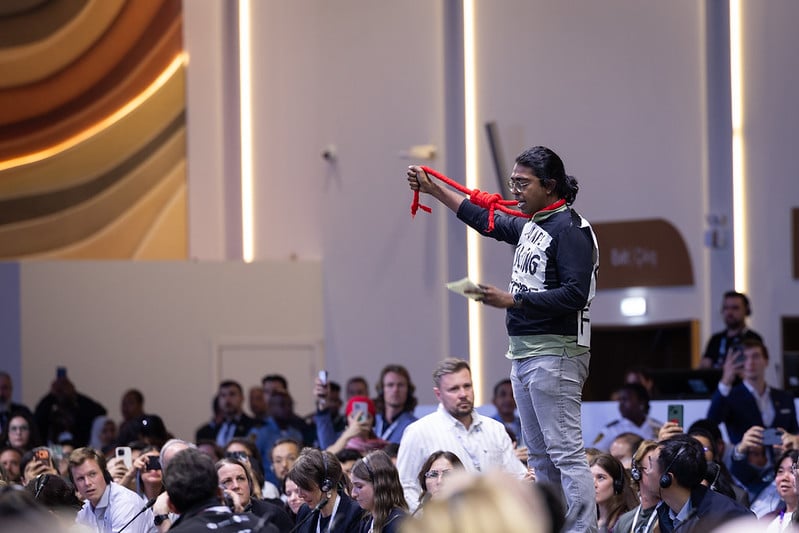
A protester expresses his displeasure at his perceived lack of progress at the summit. (Photo: © UN Climate Change – Kiara Worth)
Connect To Funds closes the Startup Zone
その スタートアップゾーンの Connect To Funds day on 20 November closed the summit’s start-up programme. By the time of writing, organisers hadn’t published investment totals or named any rounds from the day. Hasan Karadeniz, the zone’s director, それを説明しました as the first area for start-ups in 30 years of COPs. Company announcements in the coming weeks will show whether founders closed deals there.
Carbon credit rules stay divided
Guidance for the Paris Agreement Crediting Mechanism, the UN’s new carbon credit scheme, remained under negotiation as of 18 November. The Alliance of Small Island States backed text letting authorised units sent to the Adaptation Fund be sold. In contrast, the Arab Group preferred no text at all.
Countries also split over fees for the Article 6.2 registry and technical reviews. The African Group would explore charging private entities that use them, while opposing charges on participating countries. Project developers will want the final wording on fees, because it feeds straight into the cost of issuing credits.
Ocean plans set 2035 targets for coastlines and ports
A cooperation initiative launched with the Antalya Ocean and Seas Compact sets 2035 targets for coasts and ports. It calls for at least 20 per cent of degraded priority coastlines to be restored. It also backs cleaner maritime energy, greener ports and wider early warning for coastal communities. Meanwhile, the Sustainable Shipping Initiative and more than 35 organisations called for blue shipping corridors. These would pair zero-emission ships with ocean protection.
On the ocean theme day, more than $30m was announced for reef projects in 22 developing countries. The EU joined the Blue NDC Challenge, and Canada and the EU sought backing for OceanEye, a UNESCO ocean monitoring alliance. Joanna Post leads ocean observations at UNESCO’s Intergovernmental Oceanographic Commission. “Satellites cannot see beyond the surface of the ocean,” she said. That gap leaves room for companies building ocean sensors and data services.
What the fortnight delivered for start-ups
British, Norwegian and Canadian development lenders formed the 10by30 pact to steer $10bn into emerging markets by 2030. GFANZ opened a public Catalytic Capital Repository, and the World Bank Group tabled a $17.6bn package. The EBRD committed $6bn to Türkiye’s REACT platform. Even so, these deals landed against a fall of more than 70 per cent in 公的気候変動対策資金拠出の約束 裕福な国々から。
The 35-by-35 electrification pledge passed 75 countries, and companies can now sign it directly. The Electrify Now Finance Coalition, the rooftop solar target of 300 million homes and a maritime electrification goal followed. Ocean plans added 2035 targets for coastline restoration and greener ports. For industry, the Antalya Green Industrialization Compact priced near-zero steel and cement at more than $500bn by 2035. 業界の日 also brought the Antalya AI Pledge, with 80 endorsements, and an AI-Enabled Cleantech Initiative for pilots.
On carbon markets, the Coalition to Grow Carbon Markets published a policy playbook, and the compliance market coalition added Korea and Indonesia. Inside the talks, the first draft backed carbon removal and a 500 million tonne carbon capture goal. By the second draft, carbon capture faced open opposition, and the rules for the UN credit scheme were still contested.
What comes next before COP32 in Ethiopia
The third draft and any final decision will settle which signals survive, including the 35 per cent electrification goal. Ethiopia was endorsed in 2025 to host COP32 in Addis Ababa in 2027. Before then, the second Global Stocktake begins its technical assessment, and the IEA will track progress on electrification.
AMPLIFi, 10by30 and the World Bank package now need project pipelines, and the Antalya compacts need signatories to publish plans. CSN will follow the money as it moves from pledges to signed deals.
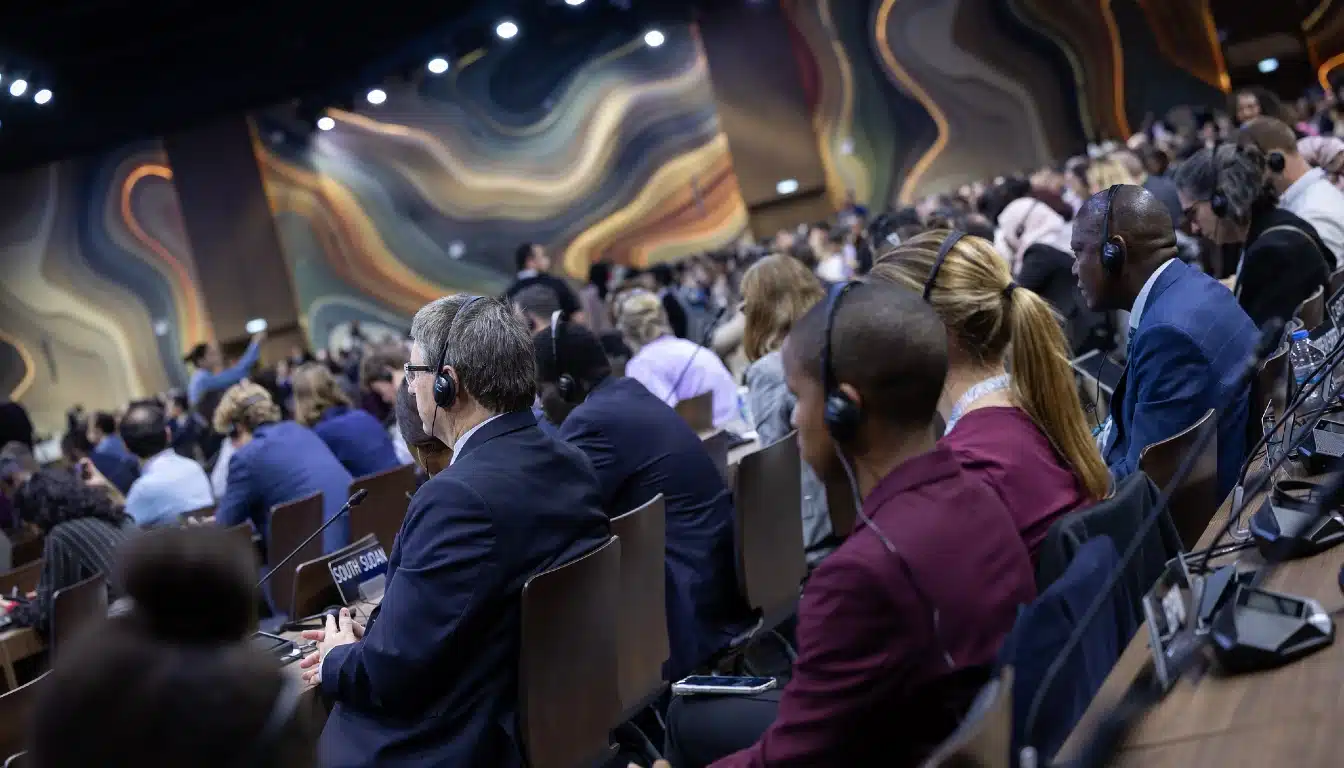
Delegates during the closing plenary (Photo: © UN Climate Change – Kiara Worth)