
Oil producers blocked any reference to fossil fuels and the summit’s headline deal fell apart. Away from it, climate tech companies leave Antalya with new grid money, working carbon market rules and a big electrification coalition.
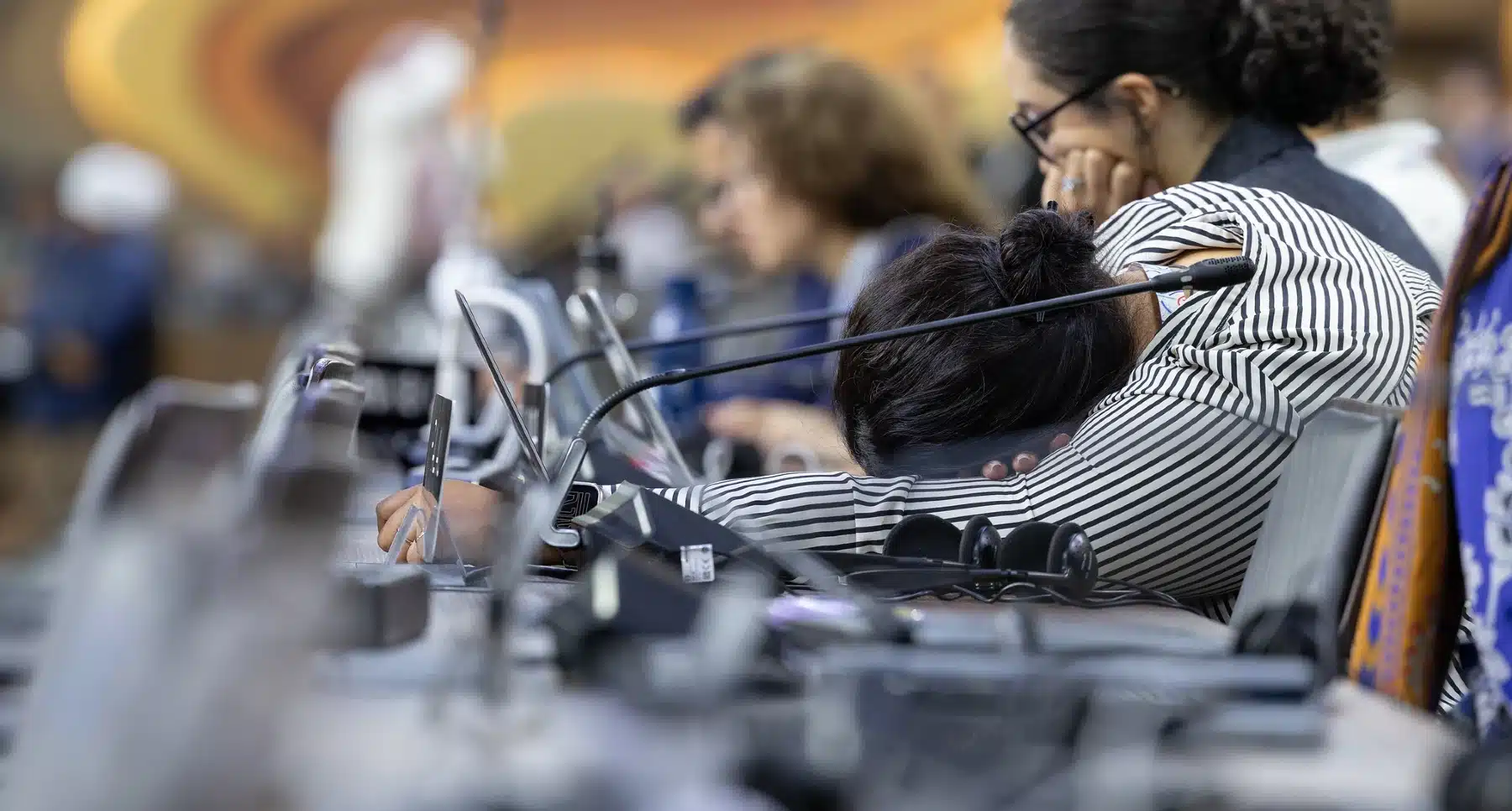
Nearly 200 countries left Antalya without the overarching agreement that Türkiye’s presidency had promised. The proposed Antalya Pact collapsed in overtime because its final text made no reference to oil, gas or coal.
COP31 president Murat Kurum, Türkiye’s environment minister, conceded the point at the closing plenary. “I understand that there is no agreement on this text. For that reason, these decisions have not been adopted,” उन्होंने कहा. The talks ran almost two days past their Friday deadline, making Antalya the longest COP on record.
यह था first time since Copenhagen in 2009 that a UN summit failed to adopt its main cover decision. UN Secretary-General António Guterres called the result a deeply disappointing setback. “There may be no consensus in the negotiating room. There is no ambiguity in the science,” he said.
Two camps formed over fossil fuels
The dispute centred on whether the text should repeat the COP28 pledge to transition away from fossil fuels. Around 130 nations wrote to the presidency to say any deal must set out a path away from them. The EU, the UK and small island states such as Tuvalu refused to accept a text without that language.
Saudi Arabia and fellow OPEC members blocked any mention of a phase-out and pressed for carbon capture instead. Russia opposed any wording on fossil fuels, arguing that oil and gas still have a role in 1.5C pathways. Speaking for the Arab Group, Saudi Arabia also objected to critics labelling carbon capture as greenwashing.
At least 32 countries formally rejected the cover decision. Panama went further than most, as its environment minister, Juan Carlos Navarro, demanded a cap on oil production. The EU said it wouldn’t endorse a pact “that does not even mention fossil fuels”.
Cosima Cassel is programme lead in climate diplomacy and geopolitics at the think tank E3G. “A small group of blockers set the outcome against the clear position of a large majority,” she said. Joeri Rogelj, professor of climate science and policy at Imperial College London, said that “even simply echoing these agreed outcomes was politically too challenging”.
Carbon market rules survived the collapse
The failure of the cover text left the rest of the COP31 outcome intact. Countries adopted decisions on carbon trading, the just transition, the Adaptation Fund and transparency in the closing hours.
For carbon project developers, the Article 6 rules are the most direct result. Countries agreed texts on bilateral trading under Article 6.2 and on the UN-run crediting mechanism under Article 6.4. Negotiators blocked attempts to weaken existing standards. The Article 6.4 rules are due for review in 2028.
The Adaptation Fund will now receive a 5 per cent share of proceeds from the Article 6.4 mechanism. As a result, it gains income that sits outside national budget politics. Joe Thwaites, senior advocate for international climate finance at the Natural Resources Defense Council, called the decision “one bright spot”.
Technical reviews still found 543 inconsistencies across 16 national reports under Article 6.2, and the final text only “takes note” of them.
Electrification drew money and backers
Electrification was the presidency’s flagship theme, and it attracted the summit’s largest pool of capital. The 35 by 35 pledge would lift electricity’s share of final energy use from about 23 per cent to 35 per cent by 2035. The goal fell away with the cover text, although Kurum said around 80 countries backed it.
इस बीच, Electrify Now Finance Coalition launched with the World Bank Group, the EIB, the EBRD, the IEA and the OECD among its members. The Climate Investment Funds put $94m of catalytic finance behind it. The aim is to draw more than $1.2bn of private capital into clean power, grids and storage in developing countries.
Members of the Utilities for Net Zero Alliance also raised their annual investment plans to at least $156bn across grids, renewables and storage. The 89-member alliance built more than 21,000km of new grid in 2025, a 50 per cent rise on the year before.
That pipeline covers the grid, storage and flexibility markets where many hardware and software start-ups sell. Fatih Birol, executive director of the IEA, said: “Electric technologies are often cost-competitive and can improve energy security for fuel importers.” The presidency’s package also set a goal for electricity to meet 20 per cent of shipping’s energy demand by 2035.
New routes from pilot to deployment
Several action agenda initiatives target the gap between demonstration and commercial scale. Türkiye’s AI-Enabled Cleantech Initiative is अंतरराष्ट्रीय जा रहा हूँ, and it connects start-ups with adopters and capital. In addition, the Antalya Green Industrialisation Compact is designed to speed up investment in cleaner steel, cement and other industrial products. It also sets out to create markets for them.
British International Investment, FinDev Canada and Norway’s Norfund साझेदारी शुरू की to raise $10bn of transition investment in emerging markets by 2030. Philanthropic partners pledged $480m for methane and other super pollutants. Türkiye and UNDP launched a climate implementation bridge, with an initial $3m, to turn national plans into bankable projects.
UN climate chief Simon Stiell argued that this second track had delivered. “This COP process has two tracks. And across the action agenda, COP31 has delivered real progress and concrete results,” he said. Ralph Regenvanu, Vanuatu’s climate change minister, was less convinced and said “the action agenda has not necessarily led to action”.
Carbon capture lost its strongest signal
Carbon capture companies had the most riding on the cover text, so they lost the most when it fell. The final draft set a goal of 500 million tonnes of carbon capture a year by 2035. Earlier drafts also backed carbon removal, and none of that language now carries formal weight.
Climate Action Network counted a record 700 carbon capture lobbyists in Antalya. The group welcomed the text’s failure and criticised its electrification target for not being tied to renewables. Developers relying on public money face a second problem. The final draft had already dropped a $120bn adaptation finance target.
अगला क्या हे
The open questions on fossil fuels and finance now pass to COP32 in Addis Ababa, Ethiopia, in November 2027. Formal agreement on a just transition mechanism is due there, and this year’s decision mentions critical minerals for the first time. At the leaders’ summit, Ethiopia’s prime minister, Abiy Ahmed, pointed to his country’s fossil fuel-free power grid.
Outside the UN process, 57 countries met in Santa Marta, Colombia, in April to promote cooperation on phasing out fossil fuels. Calls to reform the consensus rule at COPs are also growing. The Global Carbon Project projects fossil carbon dioxide emissions of 32.8bn tonnes in 2026, a fall of 0.4 per cent. Oil emissions are down 1.9 per cent, while coal emissions are still rising slightly.
आपको यह भी पसंद आ सकता हैं
 ग्रीनली के अनुसार, COP31 का 35 बाय 35 विद्युतीकरण संकल्प स्वच्छ ग्रिड पर निर्भर करता है।
 COP31 अंताल्या: कार्बन बाजार गठबंधनों के बढ़ने के साथ ही मसौदा समझौते में कार्बन उत्सर्जन कम करने का समर्थन किया गया
 COP31 अंताल्या: विद्युतीकरण पैकेज के कारण ग्रिडों को धन आवंटित होने से वार्ता में निर्धारित समय से अधिक समय लगा।