The Battery Innovation Programme is backing recycling, materials, data centre storage and skills, with the goal of cutting the UK’s reliance on battery supply chains overseas.
Innovate UK has awarded £28.6m to 27 projects through the Battery Innovation Programme. It runs the programme for the Department for Business, Innovation, Science and Trade. The awards cover battery materials, recycling and UK manufacturing, and should cut the country’s reliance on overseas supply chains.
The money splits across three rounds. Nine concept development projects share £18.74m, while 15 feasibility studies share just over £6.2m. Meanwhile, three skills projects share £3.6m. UK Research and Innovation published the results on 12 November.
Recycling without acid
Lithium Battery Recyclers Ltd will get more than £1.2m for Reclaim. It’s a UK process for recycling old electric car batteries.
The University of Leicester came up with the method. It uses a little vegetable oil in water to separate materials, including graphite. There’s no acid leaching and no hazardous chemicals.
The company will scale the process up at a pilot plant in Widnes, Cheshire. It will then check whether the recovered materials work in new batteries. If it succeeds, recycling would use less energy and more battery materials would stay in the UK.
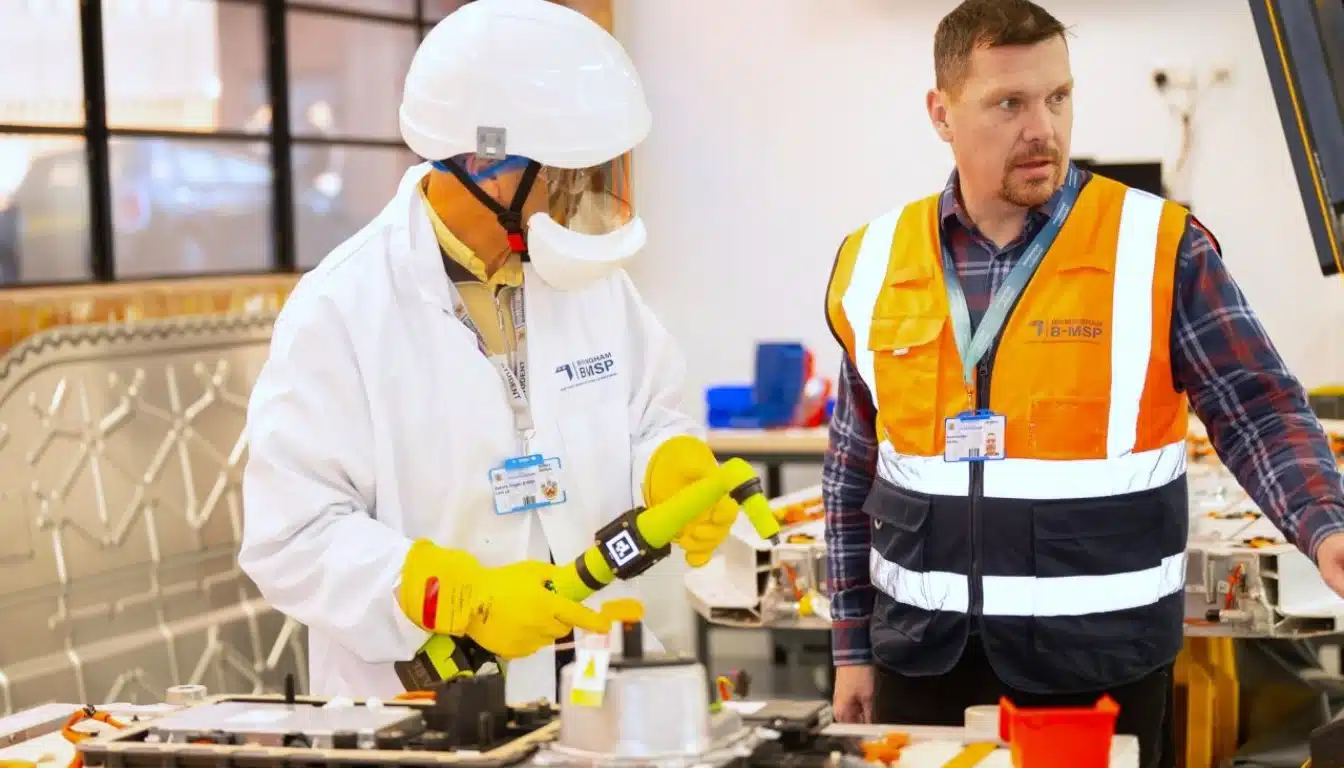
Hyperbat, now part of Unipart Manufacturing Group, will get more than £2.4m. Its battery innovation work should cut the number of electric cars written off over faulty batteries. It will build a process that checks each pack and decides what happens next. A pack could be repaired, reused, given a second life in energy storage, or recycled safely.
A water-based battery for data centres
Among the feasibility studies, Superdielectrics Group and Sytronix will get almost £500,000 for a water-based battery for data centres. The battery can store and release power quickly. The partners will build it on an existing pack and test it against the shifting power needs of AI.
If it works, data centres could keep their existing grid connections and expand without waiting for local grid upgrades. UK Research and Innovation also presents the battery as a safer alternative to lithium-ion that uses fewer imported materials. Other start-ups are chasing the same demand, including Peak Energy, which raised funds to take sodium-ion storage into data centres.
Materials and supply chains
The battery innovation money in the concept round leans heavily on materials. Evove’s Genesis project will work on making battery-grade lithium hydroxide directly at UK mine sites. Amplisi is developing drop-in silicon anodes for long-life lithium-ion cells.
FluoRok recently raised money to make battery electrolyte salts without hydrogen fluoride. Here, it leads a project on a cleaner supply of fluorochemicals. Recycling features too. Recyclus Group leads Hermes, on hazardous specialist chemistries, while Ecobat runs Project Shredder on taking storage systems apart.
Reore Technologies leads Cascade, which aims at recovering critical metals through cleaner chemistry. Similarly, Battery Mineral Ltd leads Project Stockman on treating critical materials.
શક્યતા અભ્યાસ
The 15 feasibility studies run for six to 12 months. They include LanthaGen Bio’s engineered proteins, which could pull rare earths from the liquid left after spent batteries are processed. Stortera is working on a low-cost aqueous aluminium-ion design for storage that lasts several days.
Elsewhere, Integrals Power is developing cheaper precursors for LMFP cathodes, a lithium iron phosphate chemistry. Gaussion will use magnetic fields in the final stages of cell production. Entropyst is making graphite anodes from industrial waste gas.
Skills for gigafactories
Three regional training projects share £3.6m. University Centre Somerset will run Level 2 and 3 courses for the South West battery cluster. They include jobs linked to the Agratas gigafactory near Bridgwater. University College Birmingham will extend its skills pathway to Levels 4 and 5.
In the North East, Newcastle University and New College Durham will do the same, building on their work with AESC. Blair McDougall is Minister for Reindustrialisation. “This funding will give Britain’s battery manufacturing industry the support they need to power the industries of the future,” he said.