
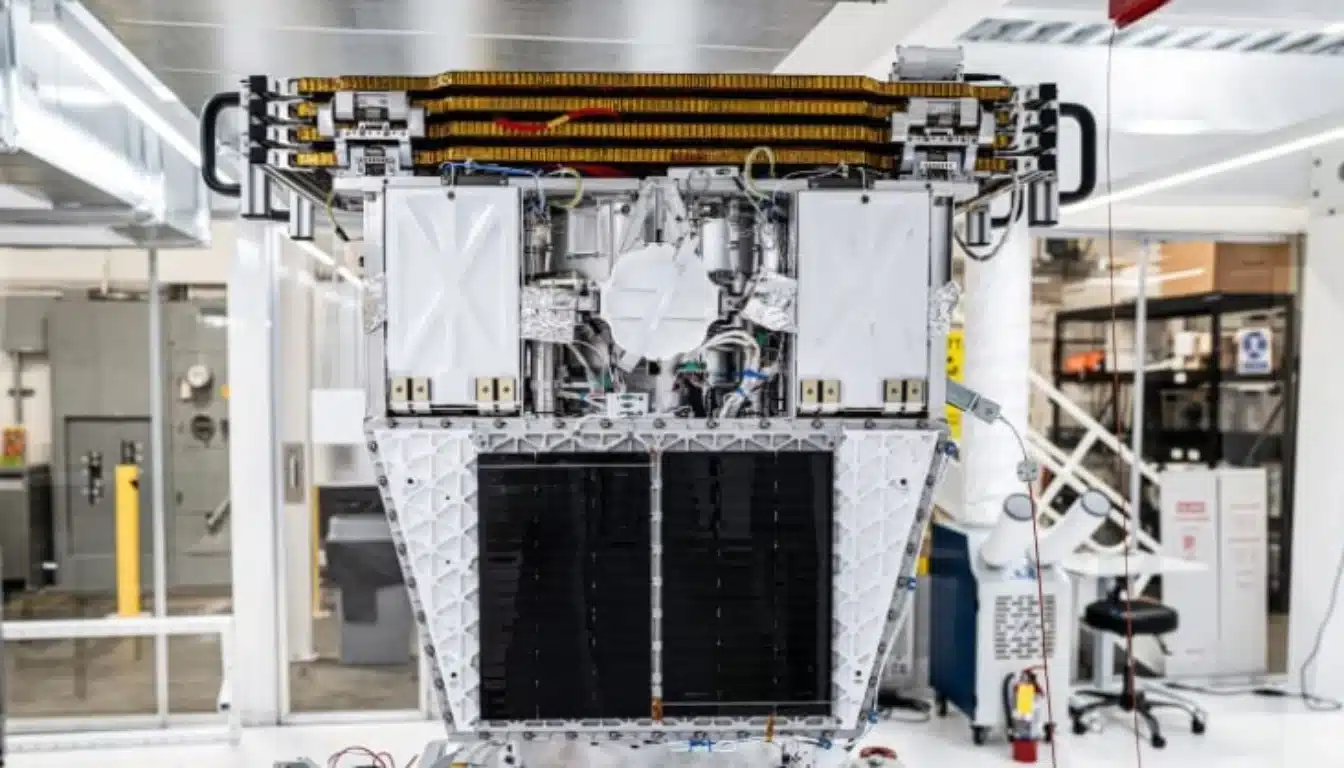
The Hawthorne, California start-up wants a fleet of satellites in low Earth orbit to reflect sunlight onto solar farms after sunset, and its total funding now tops $100m.
Reflect Orbital, a California start-up that builds satellite mirrors to send sunlight to the ground, has συγκέντρωσε $73.5 εκατ in new funding. Existing backers Sequoia Capital, Lux Capital and Starship Ventures returned for the round. Buckley Ventures, Convective Capital, The Uncommon Group and Salesforce Ventures joined them as new investors.
The deal, announced on 10 November, takes the company’s total funding above $100m. It follows a $20m Series A led by Lux Capital in May 2025 and a $6.5m seed round led by Sequoia in September 2024. However, the company hasn’t named a lead investor or said how it will spend the new money.
How the satellite mirrors work
Each satellite launches folded and then opens a square mirror about 60 feet across. From low Earth orbit, it steers sunlight onto a patch of ground roughly five kilometres wide. Convective Capital puts the brightness at about that of a full moon.
Because each satellite keeps moving, it lights any one spot for only about four minutes as it passes overhead. That short window explains the size of the company’s ambition. Reflect Orbital aims at operating as many as 50,000 satellites by 2035.
Building that fleet means fast work in the factory. The company says it makes a reflector quadrant 28 times thinner than a human hair every 3.5 days. It also says it delivers a four-boom deployable structure each week and builds a complete 12,000-part satellite every two months.
Solar farms and night-time lighting
The main commercial pitch is extra output from solar farms after sunset. Solar panels stop working once the sun goes down, so reflected light could add power in hours when a plant would otherwise sit idle. The market for that idea is large. The International Energy Agency says the world added more than 600 GW of solar PV in 2025, over three-quarters of all new renewable capacity.
Developers already add batteries to stretch solar output into the evening. In fact, investment in έργα ηλιακής ενέργειας και αποθήκευσης hit a record in the first half of 2026. Reflect Orbital wants to reach the same hours from orbit instead.
Solar power is one of several uses on its list. The company also pitches its light to search and rescue teams and to emergency crews working in disaster zones at night. Building sites and industrial plants could get extra light too, with no need for kit on the ground.
Ben Nowack, co-founder and chief executive, previously worked as an engineer at SpaceX and Zipline. He co-founded the company with Tristan Semmelhack. “We’ve made substantial progress on our journey to deliver net new, clean solar energy to a world that urgently needs it,” Nowack said.
Licences and launches
The Federal Communications Commission (FCC) has licensed the company’s first demonstration satellite, Eärendil-1. Reflect Orbital says its first demonstration mission will launch in the second quarter of 2027. The flight will check how the reflectors deploy and perform in orbit.
Meanwhile, the company has filed with the FCC for a developmental satellite, which still needs approval. In October, it also bought two dedicated launches from India’s Skyroot Aerospace. One will fly on the Vikram-1 rocket and the other on the larger Vikram-1U.
Astronomers push back
Astronomers have objected to the plans. The American Astronomical Society said it was “dismayed” by the licence. In reply, the FCC said one satellite was unlikely to raise astronomy or environmental concerns. It declined to rule on the larger fleet.
Reflect Orbital says it works with dark-sky groups and only lights sites with permission. Still, any licence for a full fleet of satellite mirrors will need a fresh FCC decision.
Other start-ups chasing energy from orbit
Several start-ups in Europe and the US are also working on energy from space. Luxembourg’s TerraSpark raised more than €5m in pre-seed funding in March to beam energy to Earth. Turin-based ORiS raised €5m in July to recharge satellites in orbit with lasers. Star Catcher Industries raised a $65m Series A in May for an orbital power grid.
Those companies transmit energy, whereas Reflect Orbital redirects sunlight, so they don’t compete directly. Its satellite mirrors will face their first real trial in orbit when the 2027 demonstration flies.
Μπορεί να σου αρέσει επίσης
 Η Aligned Climate Capital στοχεύει σε 500 εκατομμύρια δολάρια για το Ταμείο Κατανεμημένης Ηλιακής Ενέργειας
 Η Rune συγκεντρώνει 40 εκατομμύρια δολάρια για την εγκατάσταση αρθρωτών κέντρων δεδομένων σε ηλιακά πάρκα
 Η CIOC Energy εξασφαλίζει 3 εκατομμύρια ευρώ για βελτιστοποίηση ηλιακής ενέργειας και μπαταριών