The California company says its humidity-first systems cut energy use by 30% to 60% against standard air conditioning, and will use the new money to expand manufacturing and sales.
Mojave Energy Systems has raised $19 million to scale its liquid desiccant air conditioning. The company, based in Sunnyvale, California, said on 23 September that Fairtree Elevant Ventures led the Series B round.
River Bay Investments, also new to the company, made a large investment. Past backers At One Ventures, Fifth Wall, Myriad Venture Partners and Starshot Capital joined in, along with new investors Cleo Capital and MetaTrail.
Mojave will use the money to grow its sales team and build more units. It will also keep working on new products for its ArctiDry range. The round follows the launch of a second product earlier this year.
Drying the air as a job of its own
Most air conditioners dry the air as a side effect of cooling it. They chill the air until water drops out, and then often warm it back up. That takes a lot of energy, above all in humid places.
Mojave takes a different route. Its systems handle humidity and temperature on their own tracks. They use a liquid desiccant, a salty liquid that pulls water out of the air. The company calls this approach Humidity Performance.
“We’re thankful for the strong support from existing and new investors during this exciting phase of the business,” said Phil Farese, chief executive of Mojave. He said demand keeps rising because customers “are done treating humidity as a side effect of cooling.” Farese added: “This funding lets us bring the Humidity-First Climate Systems that only Mojave’s ArctiDry platform can offer to more buildings, faster.”
Two products so far
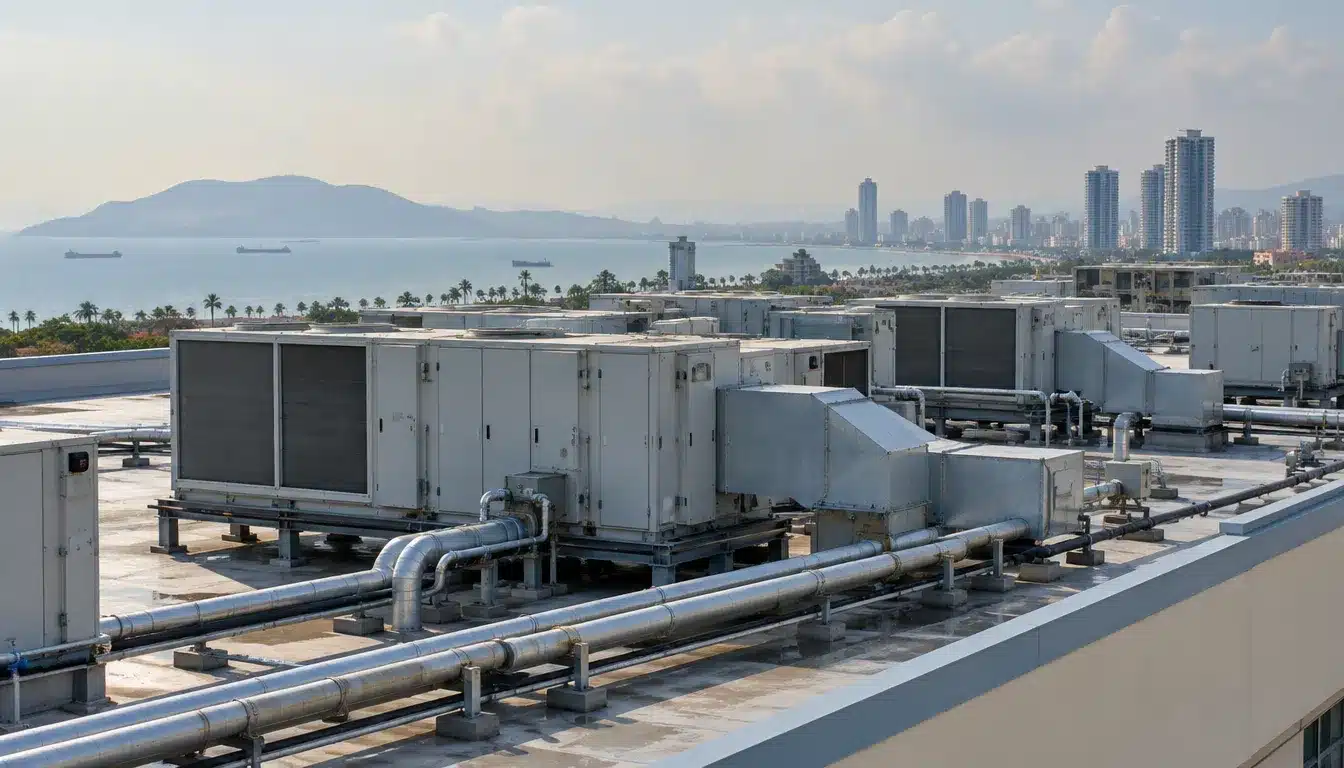
The first product, ArctiDry DX, is a patented liquid desiccant air conditioner. Buildings often use it to treat fresh air from outside before it enters the rooms.
This year, Mojave added ArctiDry Hydro for sites that already run chilled-water plants. It uses normal chilled-water temperatures to reach supply-air dew points as low as 25°F, or about minus 4°C. Mojave says chilled-water systems can’t get that cold alone. The dew point is the temperature at which water starts to condense, so a lower dew point means drier air.
The Hydro unit also stretches the capacity of existing chillers. As a result, Mojave says it can lift a plant’s overall efficiency by up to 20%.
Energy and payback claims
Mojave’s customers report 30% to 60% lower energy use than standard HVAC systems. They usually see payback in under 18 months, the company says. Those are Mojave’s own figures.
The firm sells to grocery, industrial, healthcare, hospitality and education buildings. Supermarkets, for instance, need dry air to stop fridges fogging and freezers icing up. Hospitals and schools also need steady humidity for comfort and health.
David Evans, managing director at Fairtree Elevant Ventures, says the kit is already in use. “Mojave has turned years of engineering work on liquid desiccant technology into equipment that building facility teams are rapidly putting to use,” he said.
Tom Leonard, chief executive of River Bay Investments, pointed to his firm’s contacts. “Mojave has the solution today’s buildings need, and we’re already putting our network to work for it,” he said.
Cooling demand keeps climbing
Cooling is one of the fastest-growing uses of power worldwide. Hotter summers and rising incomes push demand up, and much of it comes at peak times. Meanwhile, governments are starting to act. The Global Cooling Pledge launched a new heat roadmap this month.
In that light, systems that use less energy to dry the air could ease strain on grids. They could also cut bills for shops, schools and hospitals in hot, damp regions.
Mojave now has the money to build more units. Its Hydro product also gives it a route into buildings that already run chilled-water plants. Its next test is to show that liquid desiccant systems can win buyers well beyond early adopters.