
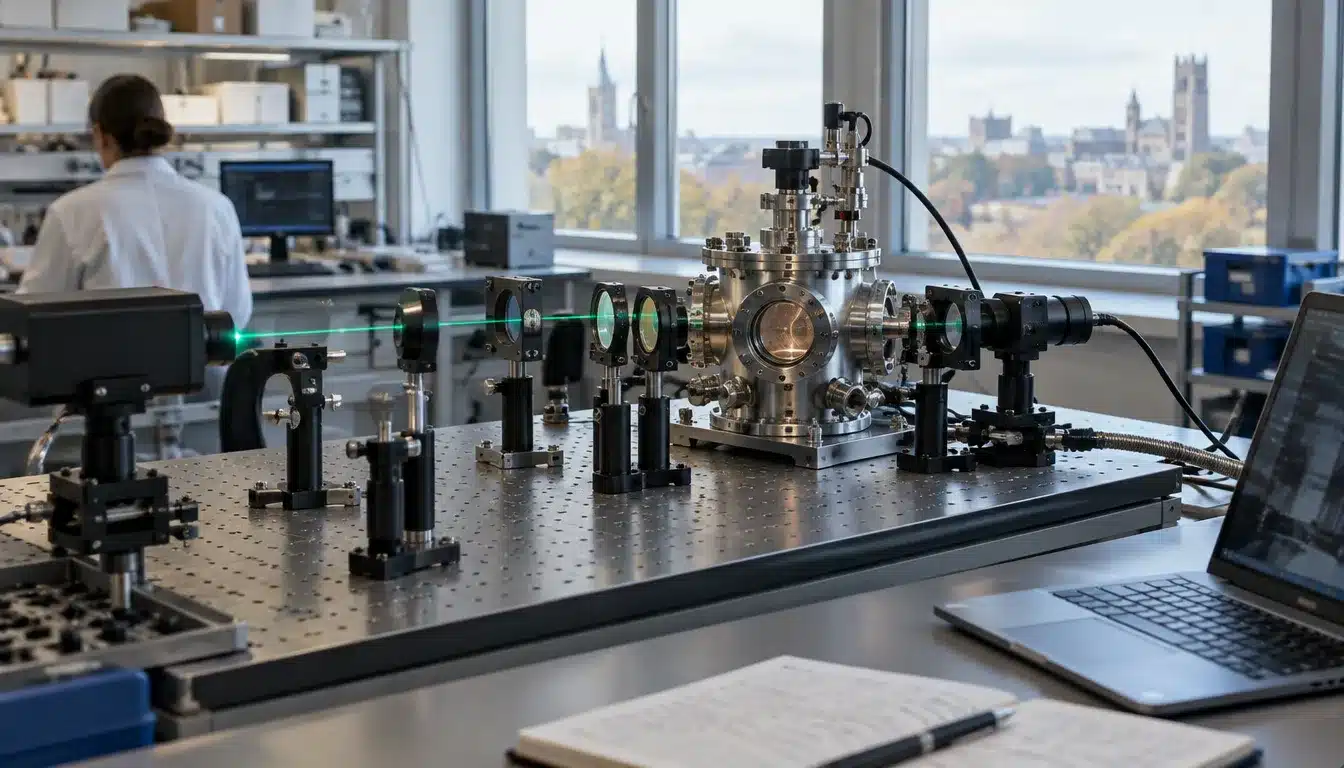
A Massachusetts start-up has raised $6.2m for a benchtop laser fusion machine built to run dozens of tests a day, with tritium sales planned long before any power plant.
Fusion start-up Cambridge Heavy Industries has raised a $6.2m seed round for a desktop fusion device. Azolla Ventures led the round. Overlay, the Neta Foundation, P3A, MassCEC and the Rothrock family also invested.
The company is based in Cambridge, Massachusetts. Until now it has worked in stealth from a small laboratory near MIT.
A reactor small enough for a bench
Many fusion designs rely on very large machines. By contrast, Cambridge Heavy Industries has built a device that sits on a tabletop.
“We purposely built a small modular reactor. It’s tiny, it’s benchtop,” said Yun Kai, co-founder and chief executive. “Because it’s small, it makes everything easier.”
Size sets the pace of research. Kai said the device can run 50 to 80 experiments, or shots, each day. The team then feeds that data into AI-driven simulations, which it uses to refine the design.
How the lasers compress the fuel
The desktop fusion device uses lasers to squeeze a fuel target. It follows the approach of a landmark experiment which showed that controlled fusion could release more energy than it took in.
However, the company keeps the number of lasers low. It uses two main lasers. One splits into several beam lines that deliver rings of light, one inside the other.
Those rings strike a flat, round fuel target in turn, from the outside inwards. The first ring starts a pressure wave that moves towards the centre. Later rings arrive on cue to boost it and squeeze the fuel further.
When the shock wave reaches the centre, another laser fires. That shot creates heat and a magnetic field. Then, at the right pressure and heat, fusion occurs. According to Kai, the design reaches high pressures with fairly low laser power.
Roots in an MIT chemistry lab
The idea began in the lab of Keith Nelson, a chemist at MIT. His team used laser pulses to study materials under extreme conditions. Along the way, they noticed they were getting close to the conditions fusion needs.
The company plans to build a power plant based on the concept in about a decade. To do so, it’ll have to scale up the design. Even so, the plant should be far smaller than most fusion plants, at roughly the size of two basketball courts. It’ll test whether the approach can make enough energy to run a power station.
Tritium as a nearer business
Before then, the company plans to use its small devices to make tritium. Almost every fusion power plant in development plans to burn this rare form of hydrogen.
Each plant needs only grams of tritium a year. Still, only about 40kg exists worldwide, and it sells for about $30,000 a gram. One recent study predicts the fusion industry will be about 28kg short in 2054 without new sources. At today’s prices, that gap is worth about $840m.
Fusion developers are also designing fuel systems that could make reactors largely self-sufficient in tritium. Even then, plants may still need an occasional top-up. Kai said that design work could take up to ten years, which gives his company a window to sell tritium while it works on power.
A small cheque in a costly field
The seed round is modest by fusion standards. Larger rivals have raised far more, such as Type One Energy, which recently raised $200m for a Tennessee fusion plant.
So the desktop fusion device is a bet on speed and low cost. If dozens of daily shots let the team learn faster, it may cut the time and money needed to reach a working design. Meanwhile, the tritium plan gives a route to revenue years earlier.