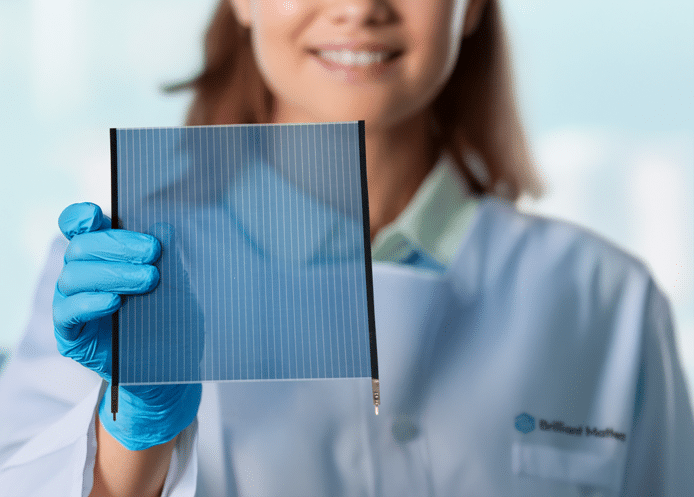
A Canadian and Swiss partnership has printed semi-transparent organic solar cells that reach 12 per cent efficiency. It now plans to sell them for glazing and greenhouses from 2028, at under $150 a square metre.
Canadian developer Brilliant Matters and Swiss materials group HeiQ have set out plans to sell semi-transparent organic solar cells. The best cell in their prototype batch reached 12.04 per cent efficiency, while the average across prototypes was 11.14 per cent. Brilliant Matters expects the product to go on sale in 2028.
The work also involved Solar Factory, a research group at Forschungszentrum Jülich in Germany. It built the cells into flexible, semi-transparent modules under Emerge, a project funded by the European Union. Fully printed prototype modules on glass then reached a top efficiency of 10.2 per cent, with an average of 10.09 per cent.
How the cells are built
Organic solar cells use carbon-based materials to absorb light. As a result, they can be thin, light and partly see-through. That lets them cover surfaces where an opaque panel would block the view, such as windows, facades and greenhouse roofs.
The partners combined Brilliant Matters’ BM10 active material with HeiQ’s Xpectra electrode, which uses silver nanowires. The electrode carries current but still lets light pass through. So the full stack can stay semi-transparent and still generate power.
Varun Vohra, engineering department manager at Brilliant Matters, said the team built the stack on glass coated with indium tin oxide. Each prototype cell measured just 0.04 square centimetres. Meanwhile, each test module linked 11 cells in series across 7.03 square centimetres of active area.
Printing at scale
The prototype modules were fully printed. In addition, Solar Factory showed that the process works with roll-to-roll printing. That method lays down each layer on a moving sheet, much like a newspaper press, so output can run without a break.
Efficiency here means the share of sunlight a cell turns into electricity. A 12 per cent cell converts about an eighth of the light that hits it. See-through cells give up some output by design, because light that passes through is not captured.
Brilliant Matters projects a price below $150 per square metre and expects further cuts as demand grows. Customer trials of its organic photovoltaic technology are also under way.
“We expect the technology to be commercially available in 2028,” Vohra said. Until then, the trials will show how the cells perform outside the laboratory.
Where the cells could go
HeiQ sees building-integrated photovoltaics as the main market, alongside architectural glazing and greenhouse structures. It also points to other light surfaces that could make power. In each case, the panel has to let light through while still producing electricity.
Greenhouse growers need sunlight for crops, so an opaque roof would cut yields. A semi-transparent layer, however, could pass light to the plants and generate power at the same time.
Other groups are chasing the same goal. For instance, engineers at University College London recently unveiled semi-transparent solar windows that draw power from indoor and outdoor light. Brilliant Matters and HeiQ now have a launch date and a target price to work towards.
What comes next
The headline figures come from small prototypes, and larger panels usually lose some performance. The module results already show part of that gap, at 10.2 per cent against 12.04 per cent for the best single cell. Customer trials should reveal how the organic solar cells handle real buildings, weather and ageing.
Lifespan is the other big question. These carbon-based layers can break down under heat, light and damp, and that has long held the field back. Buyers of glass for buildings expect it to last for decades, so trial data on wear will carry as much weight as the efficiency figures.
The partners want a printed, semi-transparent product on sale in 2028, priced below $150 a square metre. If they hit it, organic solar cells could become a real option for glass that also makes power.