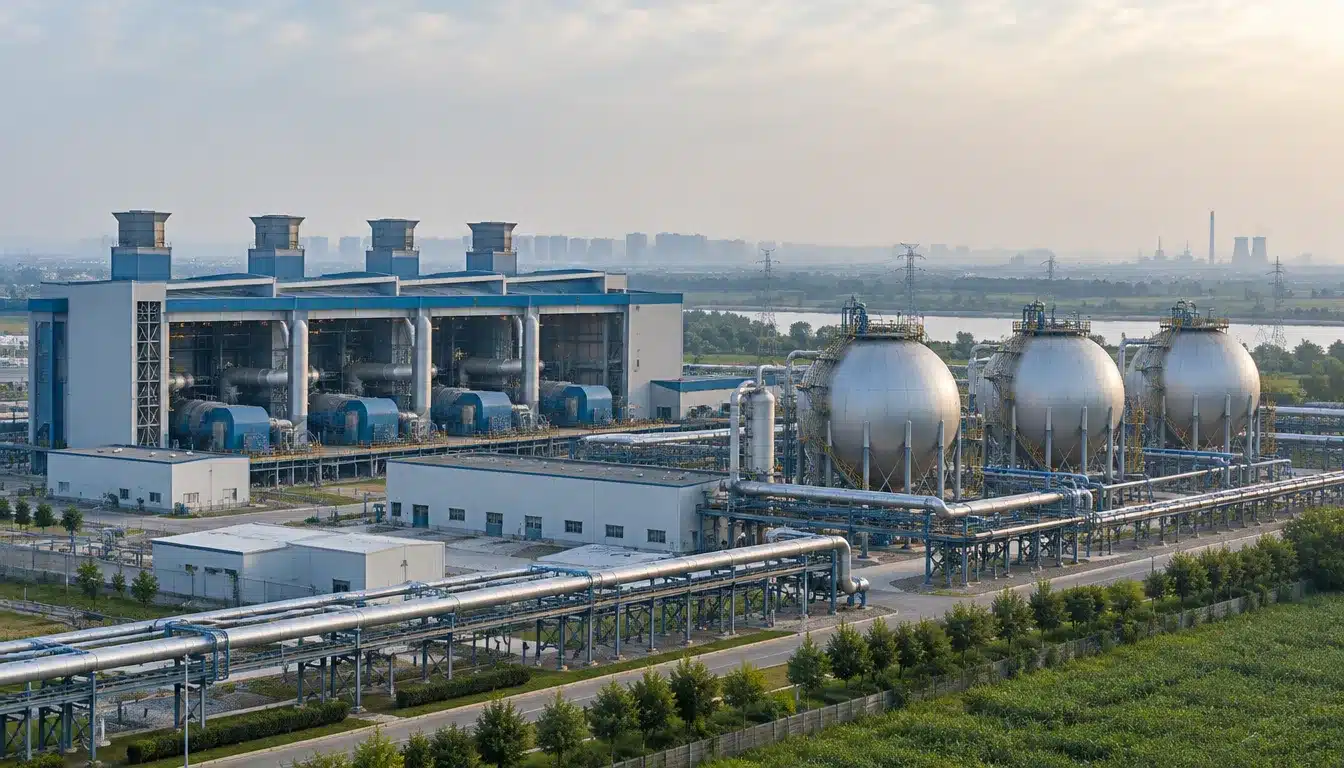
Both 350MW units at China’s Jintan salt-cavern plant in Jiangsu have completed full-system startup, taking compressed air energy storage to 700MW at one site ahead of grid connection.
China’s second-phase Jintan project in Changzhou, Jiangsu province, reached full-system startup of both units on 12 September. The plant is a compressed air energy storage site with 700MW of capacity across two 350MW units. No salt-cavern plant of its kind reported worldwide has more installed power.
China Huaneng and China Salt Group are building the project together. Their local arms, Huaneng Jiangsu and China Salt’s salt-cavern unit, handle building and running it. Tsinghua University and the Xi’an Thermal Power Research Institute gave technical help. Meanwhile, SEPCO1, part of PowerChina, built and installed Unit 2.
Full-system startup means both units ran joint startup tests under real working conditions. It is the last big step before the plant joins the grid.
The site itself explains the partnership. Salt mining left the Jintan caverns behind, which is why China Salt Group is involved. Changzhou also sits in the Yangtze River Delta, one of China’s biggest hubs of power demand.
Storing power underground
Compressed air energy storage works like a giant air battery. Its value lies in long duration, since it can hold energy for hours at a time.
The idea is simple. When power is cheap, compressors push air into four salt caverns about 1,000m below ground. Together, they hold about 1.2 million cubic metres of gas at more than 130 atmospheres.
The plant also traps the heat from squeezing the air and stores it. Later, it uses that heat to warm the air before it drives the turbines. As a result, it doesn’t need to burn natural gas, as older designs did.
A full charge stores about 2.8GWh. Charging takes about eight hours, and the plant can then run at full output for four hours. Round-trip efficiency is above 70%. That is lower than lithium-ion batteries tend to reach, a trade-off for long, large-scale storage.
Engineering upgrades for phase two
Each unit has a 350MW air turbine with three reheat stages and four expansion stages. Main air pressure reaches 13.5MPa, and the turbines are built for over 93% efficiency. Two parallel lines of four-stage compressors move more air.
Phase two also stores heat in a new way. Phase one used heat-transfer oil, while phase two uses hot water under pressure at about 180°C. Sixteen round tanks of 3,500 cubic metres each give 56,000 cubic metres of heat storage.
By comparison, the first phase was far smaller. It came online in 2022 with 60MW and 300MWh.
Output and a comparison
Those figures point to heavy use. The operators expect about 330 cycles of charge and discharge a year. That should yield about 924GWh of power a year, equal to both units running flat out for about 1,300 hours. For a grid with fast-growing wind and solar, that means moving spare power into peak hours.
Another large Chinese plant, at Feicheng in Shandong, gives a useful contrast. Zhongchu Guoneng’s site there has 300MW and 1,800MWh, with six hours of discharge and a rated design efficiency of 72.1%. It uses tech from the Chinese Academy of Sciences.
Jintan, by contrast, uses bigger 350MW turbines, parallel four-stage compressors and hot-water heat storage. So it gives more power over a shorter, four-hour discharge.
Next steps before grid connection
Jintan isn’t yet linked to the grid. Next come pre-grid-connection tests and commissioning. Once those end, the plant can start to trade power.
For grid planners, compressed air energy storage adds long-duration capacity outside lithium supply chains. However, the right salt geology exists only in some places.
Jintan’s own history shows how fast the tech has grown. Phase one had 60MW, while phase two is more than ten times larger. So the pace of Jintan’s commissioning will shape how far compressed air energy storage spreads in China.