The Portuguese developer says its lighter design held steady in simulated typhoon conditions and could cut capital costs by about 44% against standard semi-submersible platforms.
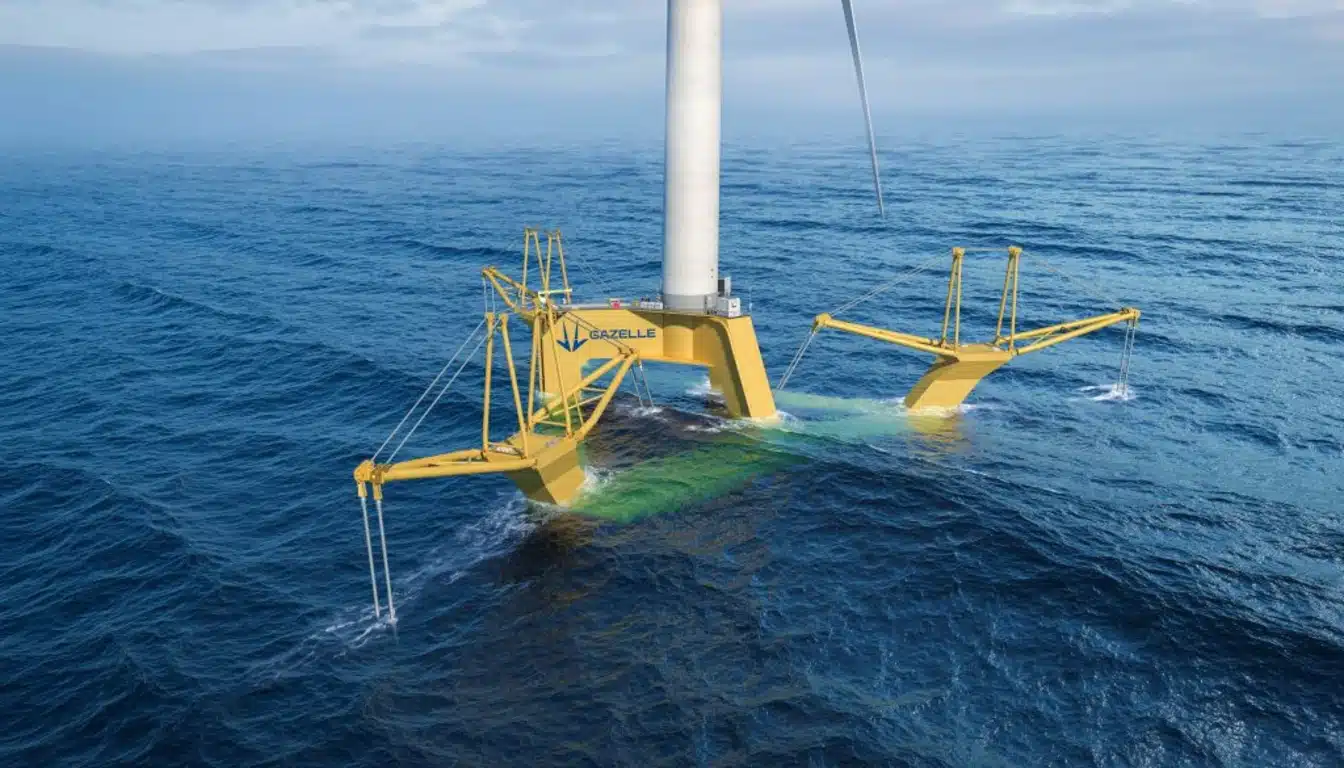
Gazelle Wind Power has designed a floating wind platform to carry turbines of 18MW and above in extreme seas. It unveiled the design on 21 September after developing it with a major Asian utility. The utility plans a large floating project at a site prone to typhoons.
Gazelle hasn’t named the utility or the site. Still, the work targets one of the main limits on floating wind. Most platforms today have to grow bigger and heavier to carry larger turbines. The new floating wind platform keeps the core ideas of Gazelle’s earlier designs but scales them up for much bigger machines.
Counterweight and mooring frames
Gazelle’s approach keeps the platform itself compact. A central counterweight hangs below the structure. Three hinged mooring frames then link it to near-vertical mooring lines.
Together, they give the platform a passive restoring force. In other words, it rights itself without the active ballast systems that pump water between tanks on many rival designs.
The new version adds a tripod support structure, upgraded mooring frames and a revised hull shape. Gazelle says those changes help the platform ride waves and spread loads more evenly. They also cut structural weight and make the platform more tolerant of damage.
Tested against typhoon conditions
Gazelle ran computer simulations for a site where typhoons hit. The conditions included a 50-year extreme wind speed of 59.8 metres per second at a hub height of 155 metres. They also included a 50-year significant wave height of 14.2 metres.
A 50-year value is the worst storm engineers expect once in 50 years at that spot. Significant wave height is the average height of the largest third of waves. So these are storm conditions a platform must survive, well beyond a normal working day.
Under those conditions, roll and pitch angles stayed below 5 degrees. Movement and loads at the tower base also stayed within design limits, in both survival and power-production scenarios.
Jason Wormald, chief technology officer at Gazelle, set out what the results mean. They show Gazelle “can scale to the next generation of 18 MW+ turbines without simply making the platform bigger and heavier,” he said.
Lower cost claims
The company’s early costing puts capital costs about 44% below benchmark semi-submersible platforms. Semi-submersibles are the most common floating design. They use large columns that float to stay stable. Gazelle also estimates the levelised cost of energy, the average cost of each unit of power over a project’s life, at about 52% lower.
Gazelle puts those savings down to several factors. They include lighter hulls and moorings, a small footprint and steel parts built in modules. Simpler installation and the option to tow the platform to port for maintenance also help.
Chief executive Jon Salazar said the company’s technology “has always been designed to reduce the material, infrastructure, and cost required to deploy floating wind.” However, these are simulation and costing results, and no full-scale unit of this design is yet at sea.
Why a lighter floating wind platform counts
Fixed-bottom offshore wind has moved quickly to turbines of 15MW and more. Floating wind has lagged, partly because every extra megawatt adds weight and steel to the platform beneath it. Bigger turbines also pay off across the whole farm. Fewer, larger units need fewer moorings and cables for the same output.
That gap is sharpest in deep waters off Asia, where many sites face typhoons. Other developers are also working on the problem, including a floating turbine built to withstand severe typhoons.
Gazelle has its headquarters in Portugal and offices in Spain and London. If its floating wind platform performs at sea as it did in simulation, larger turbines could reach deep-water sites at lower cost. The unnamed utility’s project could be the first real test.