Switzerland’s first commercial bioenergy carbon capture project has sent its first tanks of liquefied CO2 by road, rail and sea to Denmark, where the gas will be stored permanently beneath the North Sea.
Swiss carbon technology firm Airfix, plant operator CO2 Energie AG and project developer South Pole have begun commercial operations at the country’s first integrated, cross-border bioenergy with carbon capture and storage project.
The capture unit sits at the Regionalwerke AG Baden biomethane facility in Niederwil, the largest biomethane plant in Switzerland. It captures biogenic CO2 released as local agricultural and food waste is digested, then liquefies it on site. The facility is designed to handle up to 4,300 tonnes of CO2 a year, turning a by-product of biomethane production into permanent negative emissions.
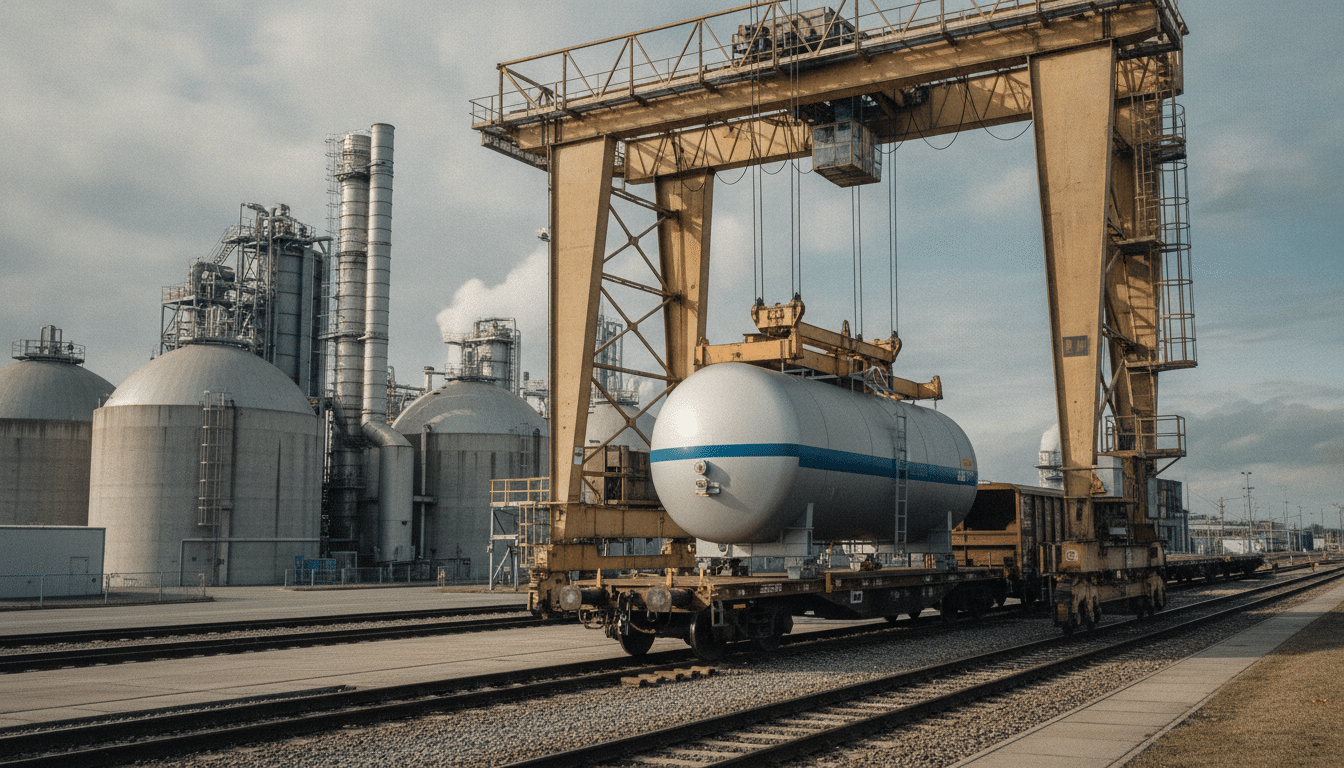
The first ISOtainers of liquefied CO2 have now left Niederwil bound for Project Greensand, the INEOS-operated storage site off the Danish coast. It is the first Swiss commercial project to store carbon abroad, and the first non-Danish project to inject at Greensand.
A landlocked country’s route to the seabed
Switzerland has no suitable deep geological storage of its own, so exporting CO2 is the only way to meet the net zero obligations set out in its federal Climate and Innovation Act. That made logistics the hard part. Airfix coordinated a multimodal chain managed by the logistics group HOYER.
Tank containers travel by truck from Niederwil to the rail terminal in Basel. From there they go by rail across Germany to Hamburg, then by road to the Port of Esbjerg in Denmark. A ship carries them offshore to Greensand, where the CO2 is injected 1,800 metres beneath the seabed into the depleted Nini West reservoir.
Every leg of that journey burns fuel, so the project accounts for transport emissions in its removal claim. After deducting them, the chain achieves a net atmospheric removal efficiency of about 91.7%. Jonas Lötscher, Managing Director at Airfix, said the successful integration shows that cross-border regulation and multimodal logistics are no longer barriers to scaling European carbon removal.
Who pays for the credits
The removal credits are certified under rules set by the Swiss Federal Office for the Environment. Revenue is underpinned by a CHF 10m ($11.6m) pre-purchase agreement from the Climate Cent Foundation running to 2030, which gives the project a guaranteed buyer through its early years.
For the wider European removal sector, the significance lies in the paperwork as much as the pipework. Cross-border CO2 transport under commercial terms is the step many biogenic capture projects on the continent have been waiting for, because it turns small, dispersed point sources into something that can be aggregated and sold. At 4,300 tonnes a year, Niederwil is modest in volume. Its value is as a working template.