Researchers at the University of California, Los Angeles have developed a 3D-printed zinc-ion battery. They report it holds more than seven times the energy of comparable devices. The findings appear in the journal Small.
The work centres on zinc-ion chemistry. Zinc is abundant and relatively inexpensive. It carries a lower safety profile than lithium. Industry and researchers have long considered it a strong candidate for stationary storage alongside solar and wind installations.
The Architecture Behind the Claim
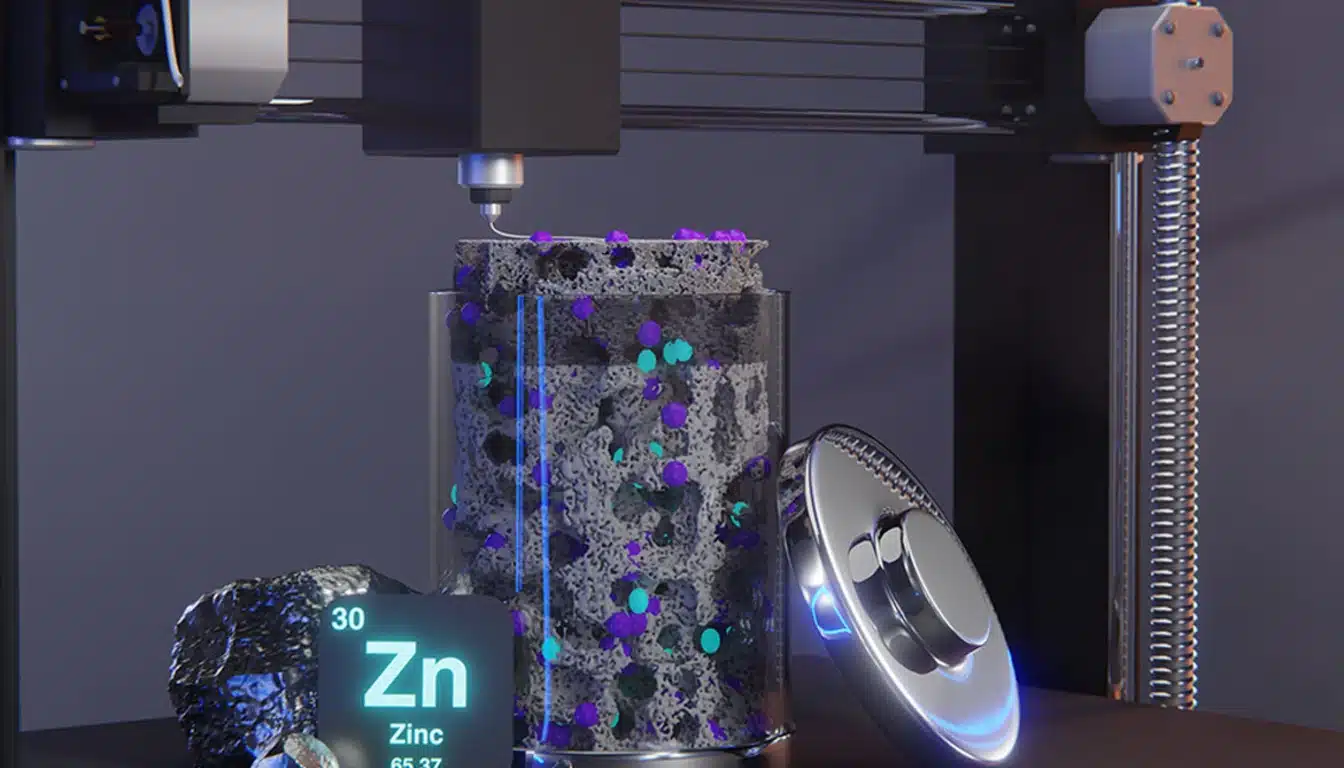
The UCLA team rebuilt the battery’s internal structure using additive manufacturing. They printed a lightweight lattice electrode and coated it with vanadium oxide. That material is responsible for storing and releasing electrical charge.
Heat treatment converted the printed scaffold into a conductive carbon framework. The process created a structure filled with tiny pores and a very large internal surface area. That geometry gives zinc ions room to move. It also allows the device to store substantially more charge than conventional designs.
Ric Kaner, co-corresponding author and professor of chemistry and materials science at UCLA, said the 3D-printed approach allows engineers to control the microstructure of the scaffold directly. He said engineers can create billions of tiny holes through this method. Those holes greatly increase the internal surface area available for charge storage.
The team describes the result as a hybrid device. It combines qualities of a battery and a supercapacitor. The design targets both high capacity and fast energy release.
Durability and the Grid-Scale Question
For stationary storage, longevity often matters more than energy density alone. The battery retained 82 per cent of its capacity after 1,500 charge and discharge cycles. Researchers examining grid-scale applications will watch that figure closely.
Zinc-ion batteries have attracted interest for stationary storage for years. Their performance has historically lagged behind lithium-ion equivalents. The UCLA result, if it holds across larger formats, would close part of that gap.
Maher El-Kady, co-corresponding author and assistant researcher in UCLA’s chemistry and biochemistry department, said the broader storage market is unlikely to be served by one chemistry alone. That view reflects the general consensus among storage researchers. Different applications require different trade-offs between cost, safety, weight, and cycle life.
The current study does not address manufacturing at scale. It also does not provide commercial cost projections. Those remain open questions.
A Secondary Tool for Laboratory Consistency
The research produced a second outcome alongside the battery itself. The team designed a sealed electrochemical test cell intended to make laboratory measurements more consistent. Sophia Uemura, first author and recent PhD graduate from UCLA, said the concept could help other researchers obtain more reliable data.
The team built the cell in Onshape and printed it on a Bambu Lab X1 Carbon printer using transparent filament. The design is intended to replace one-off custom testing rigs, which vary between laboratories and can introduce inconsistencies in reported results.
Uemura said the growing accessibility of 3D printers should make the design relatively easy to reproduce and adapt. That claim is plausible given the wide availability of consumer-grade printers, though independent replication has yet to be reported.
Where This Fits in the Wider Field
UCLA’s work arrives as research groups across the United States reassess additive manufacturing as a design tool for energy storage. A separate effort at the California Institute of Technology has applied 3D printing to lithium-ion battery architecture. Together, these projects suggest a shift in how university laboratories are using printing technology. The focus has moved from prototyping individual components to redesigning the internal geometry of cells themselves.
For investors and policymakers tracking storage costs, zinc-ion chemistry remains a long-term proposition. Lithium-ion dominates deployed grid storage today. Zinc offers a potential cost and safety advantage at scale. The UCLA results are early-stage and published from a university laboratory setting. Commercial validation would require substantially more work.
The study in Small is peer-reviewed. The research was conducted at UCLA. No external funding sources were disclosed in the available source material.