The case for rooftop solar in Britain used to make itself. A panel produced clean electricity. The grid it fed burned gas and coal. Every kilowatt hour generated was a kilowatt hour of fossil fuel displaced, and the benefits were large and evident.
Then Britain went and cleaned up the grid. Coal came off the system entirely in September 2024. Wind and solar together supplied almost half the country’s electricity last year, according to Carbon Brief’s January 2026 analysis. Each year the electricity a rooftop photovoltaic solar panel displaces gets cleaner, and each year the overall carbon it actually saves therefore gets smaller.
A clean grid, with much-reduced emissions is a phenomenal achievement. But other, non-grid technologies are now delivering proportionately higher carbon savings.
Christian Albrecht is group business development director at Naked Energy, a British firm that is emerging, confidently, from the shadow of photovoltaics, building collectors that use sunlight to heat water rather than make electricity.
Solar thermal is the older technology and the forgotten one, familiar mostly as the drums bolted to Greek and Spanish rooftops. Albrecht’s contention is that the cleaner Britain’s grid becomes, the better his technology looks – all good fashions make a come-back eventually. It’s an odd argument to have to make, and he makes it with the patience and persuasion of someone who has made it many times.
The energy a PV panel wastes
Begin with what a photovoltaic panel does with sunlight, which is mostly waste it. The industry celebrates efficiency gains in fractions of a percentage point, from 22 per cent to 23, from 23 to 23.5. Albrecht wants you to look at the other 77 per cent.
“Over a hundred percent of energy that the solar panel receives, it converts twenty-three percent to power,” he says. “The rest of the sun’s energy is converted to heat by a PV panel and that heat just makes the panel hot and it radiates out to the atmosphere. So all that energy is lost.” A PV array on a summer roof is a machine for making warmth nobody catches.
Solar thermal catches it. “Solar thermal collectors can have efficiencies of, you know, sixty, seventy, eighty percent,” Albrecht says. Naked Energy’s tubes run water to 120 degrees Celsius, which covers showers, kitchens, laundries, swimming pools and a good deal of industrial process heat.
The roofs work harder too. Conventional panels tilt south and shade whatever sits behind them, so installers leave corridors between rows and surrender half the roof to empty space. Naked Energy runs its collectors east to west and tilts only the absorber south, which makes the corridors unnecessary. “You can cover the entire service area with generating assets,” Albrecht says. He claims 85 per cent utilisation against PV’s 40 to 50.
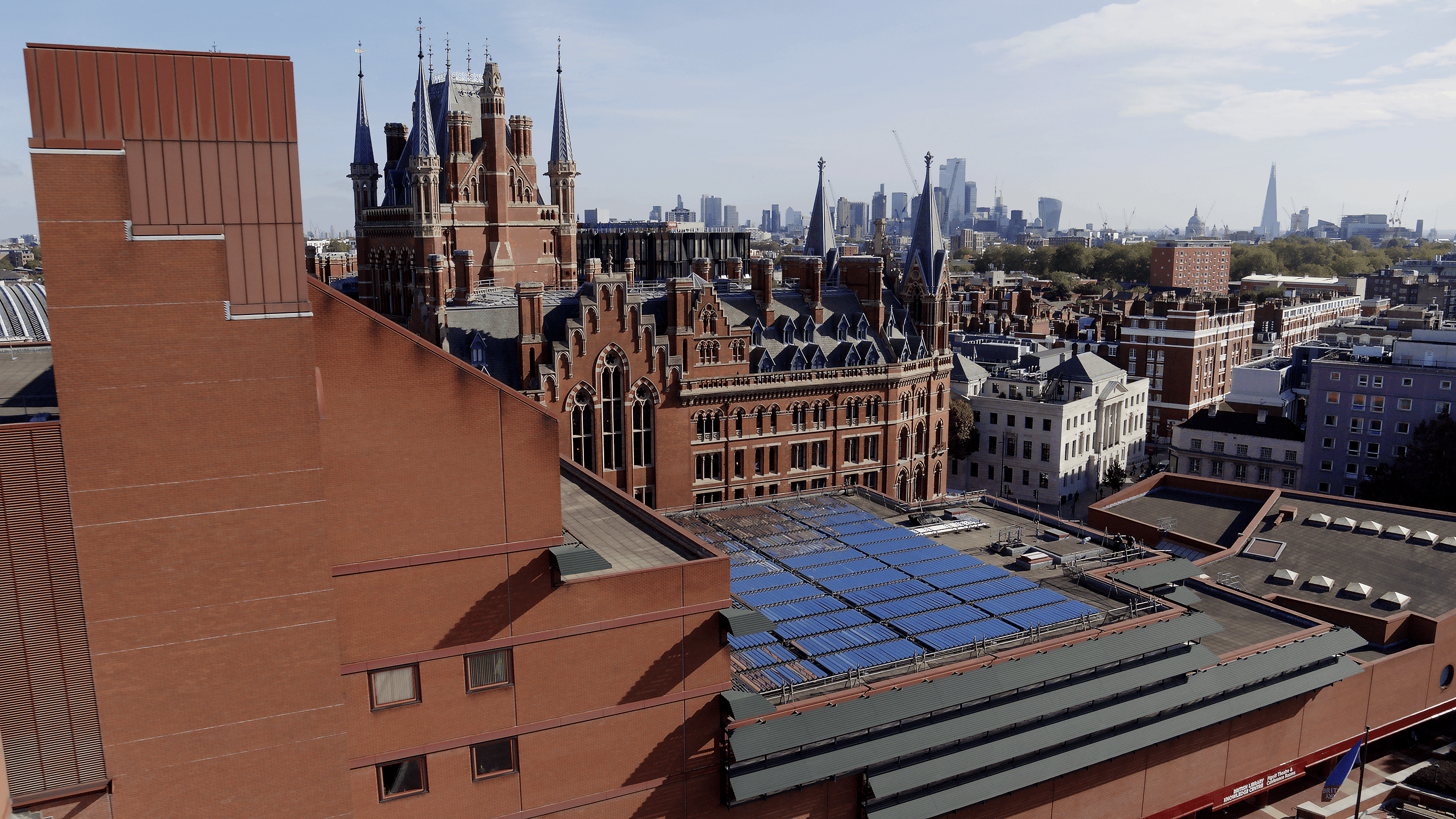
The Naked Energy installation on the roof of the British Library.
The number that refuses to fall
Efficiency is the smaller part of his case. What matters more is what each technology displaces, and what happens to that fuel over twenty-five years.
Gas can’t get cleaner. Burning it releases carbon in a fixed ratio set by the fuel itself, so a kilowatt hour of gas will emit the same in 2050 as it does today. The government’s 2025 conversion factors put natural gas at 0.183 kilograms of CO2 per kilowatt hour, barely changed from the year before. No technology upgrade shifts that number, because nothing about the fuel has changed.
Grid electricity is policy, and policy does move. Its carbon intensity has declined rapidly as renewables have scaled, and the government expects the fall to continue toward zero. Run those two lines forward across the life of a solar asset and they cross. Albrecht describes the end point without much ceremony. “The emissions factor of the electricity is expected to decline according to government projections to the point where it’s almost zero and the solar PV is not saving any carbon. It is reducing your bills, but it’s not saving you any carbon because the grid is now clean.”
A panel that saves money and no carbon is still worth owning. It is, however, a different product from the one it was probably sold as.
Solar thermal, meanwhile, spends its whole life displacing a number that never moves. “In places like the UK or even Switzerland where the grid is very clean through lots and lots of hydro power,” Albrecht says, “we can deliver an order of magnitude more carbon savings than a conventional solar photovoltaic array.”
Naked Energy puts the range at two to ten times the carbon savings of conventional solar, and Albrecht stands behind it. Two factors drive the spread, he says: the efficiency of the collector and the emissions factor of the displaced energy. The second is the one that matters most, and it is the one moving. Every year the grid decarbonises, the gap widens in solar thermal’s favour.
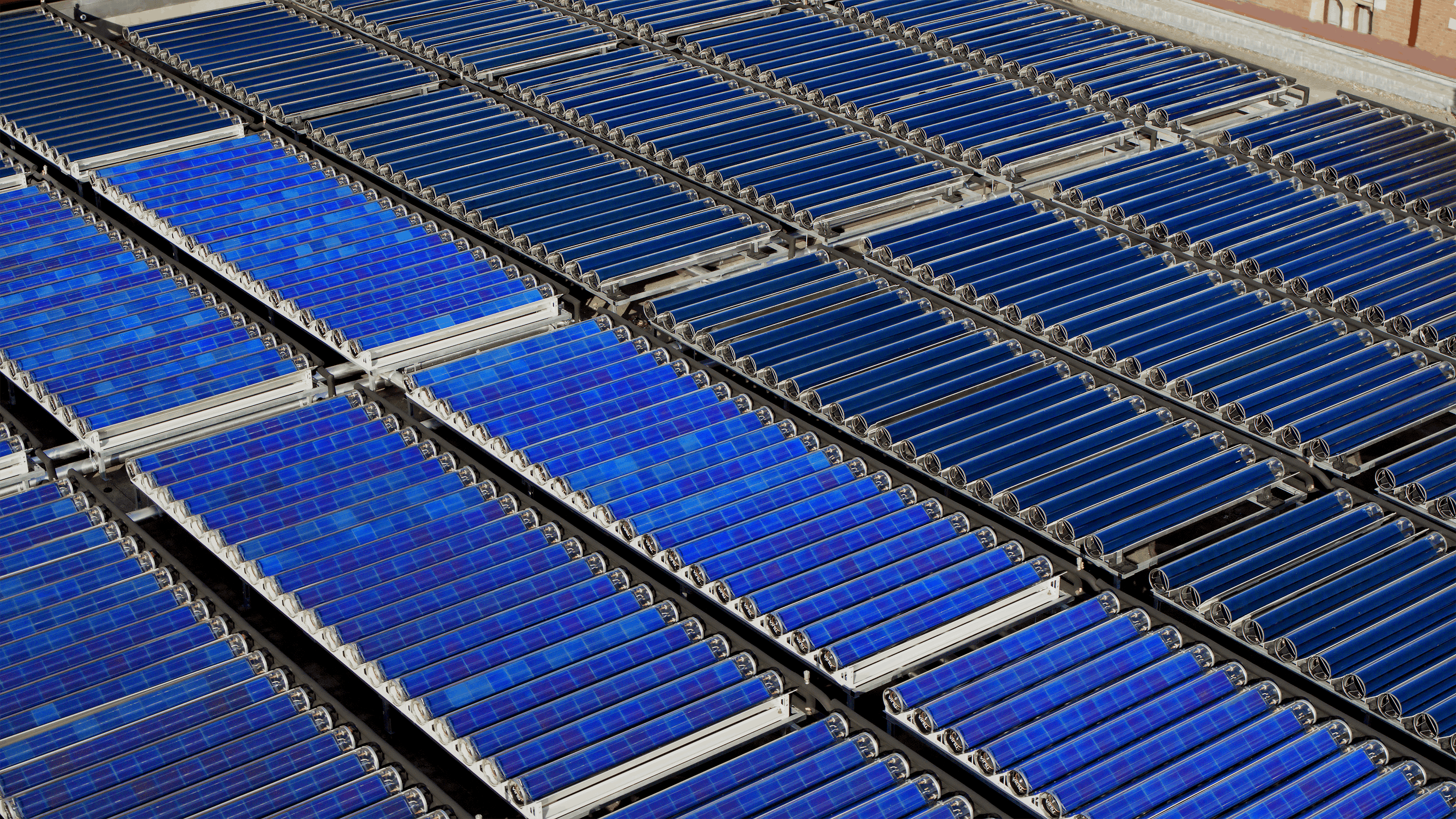
Thermal solar collectors can use more roof space than solar PV panels.
Wimbledon, Knightsbridge and the roof of the British Library
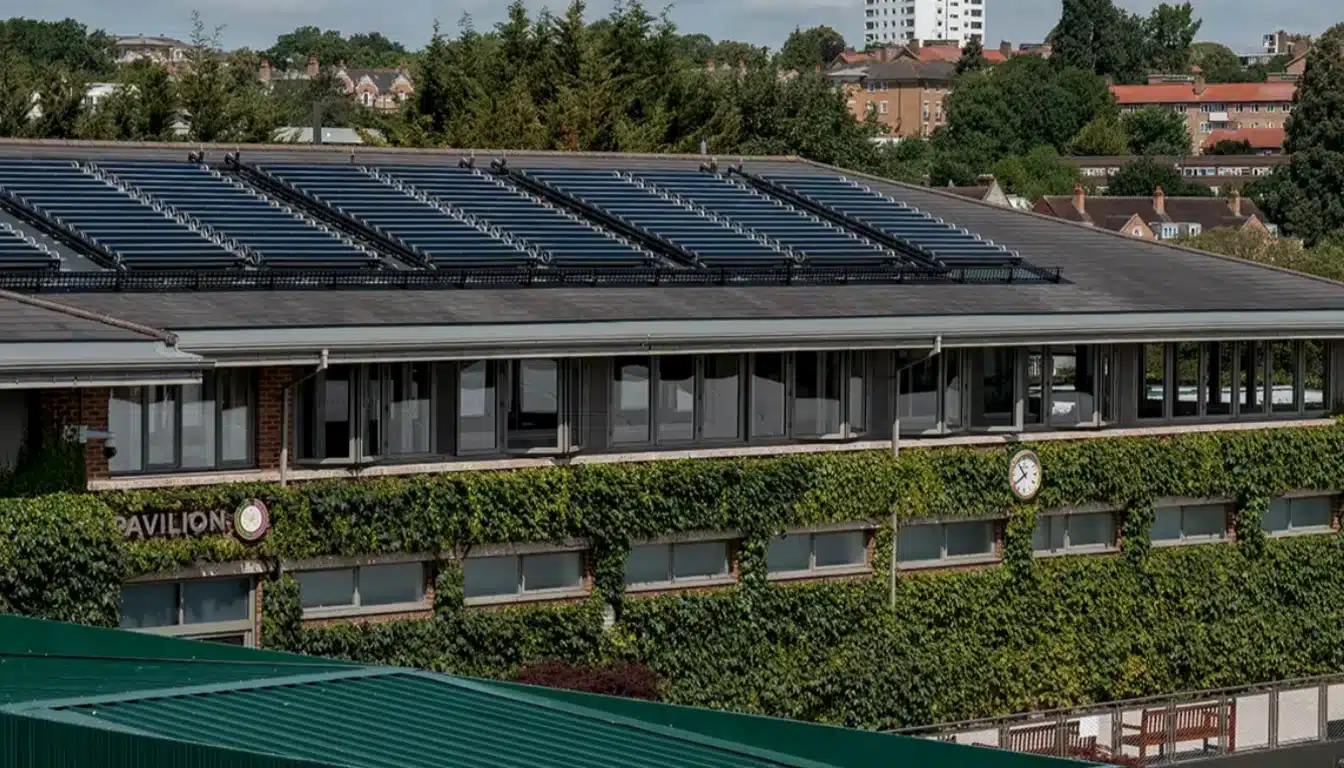
Naked Energy has 120-odd projects running, and a conspicuous number of them sit on buildings people have heard of. Its tubes heat the players’ showers at Wimbledon’s Aorangi Pavilion. There is an array at the Mandarin Oriental hotel on Hyde Park. The largest of all sits on the British Library.
The library is the more interesting story, because it should have been impossible. It’s Grade I listed, in central London, overlooked by the St Pancras Renaissance Hotel, and it now carries the UK’s largest solar thermal installation: 950 collectors across 712.5 square metres, expected to cut 55 tonnes of CO2 a year, paid for by the Public Sector Decarbonisation Scheme.
Approval meant Historic England, and glint and glare assessments to prove the neighbours wouldn’t be dazzled. “It’s quite a robust process,” Albrecht says, “but we were able to navigate that.” The system is invisible from the street, which is rather the point.
Albrecht doesn’t pretend the trophy roofs are an accident. “High profile buildings do help us garner more eyes on what we’re doing as a business,” he says, before steering firmly towards the buildings nobody photographs. “We are doing large industrial, large utility sites where visual impact isn’t important. And that’s where of course the energy density is the key consideration.”
That is where the market actually is. Breweries, pharmaceutical plants, pulp and paper, food and beverage: sites with year-round process heat and no aesthetic anxieties whatsoever. Heat is roughly half of global final energy demand and still overwhelmingly fossil-fired. The showers at Wimbledon are a shop window. The bottling plant is the business.
Nobody has €28 million just hanging around
A superior carbon performance doesn’t win orders on its own. And what can kill projects is the upfront payments required in year one.
Naked Energy is working on one European customer project costing €28 million. Ask this food manufacturer to find that money and you are competing against them building a new bottling line, a new distribution centre or a new site.
Albrecht has clearly had this conversation more than once. “We’re not ringfencing twenty, thirty million for a decarbonisation project,” he says, ventriloquising the customer. “We want to build a new bottling line in our factory.”
Hence the company’s “heat as a service” offer, built with partner E.ON through its Energy Infrastructure Solutions arm. Naked Energy and its equity partners fund the assets, build them, run them, and sell the customer heat at a fixed price per megawatt hour “which is lower than what they’re paying for gas.” The manufacturer decarbonises, hedges against volatile fuel prices and keeps its capital for the bottling line.
The logic underneath is simple. Amortise infrastructure and fuel across twenty-five years and the heat comes out cheaper than gas. “But you need the capital to invest in that in year one,” Albrecht says, “which is the problem.” The economics were always sound. The service model just moves them onto a balance sheet built to carry them.
The subsidy Britain isn’t paying
This is where the state ought to come in, but largely doesn’t. The British Library was built on the Public Sector Decarbonisation Scheme, a scheme that has since expired, with no replacement. “The current standing of subsidy support in the UK for heat decarbonisation, there’s no schemes currently available,” Albrecht says.
Cross the Channel and the picture brightens: mandates in Germany, Austria, the Benelux, Spain and Portugal, plus a renewable heat auction for industrial sites where developers bid competitively on the cost of the carbon they’ll abate.
Albrecht is admirably unbothered about saying where this leaves the company, despite its British base. “A lot of our work is in slightly sunnier climates,” he says, “and we’re really benefiting from subsidies across Europe.”
Cheap gas is the culprit he keeps returning to, and he is careful not to moralise about it. Decades of subsidy and entrenched infrastructure have made the fuel cheap, which is positive for anyone paying a bill but ruinous for anyone trying to displace it. When the incumbent is cheap, savings can’t repay investment in an alternative, and the business case corrodes before it reaches the roof.
What the clean grid is telling us
Naked Energy is closing a fresh round with a strategic partner it won’t yet name, following the £17 million Series B it announced in July 2024, led by E.ON EIS with Barclays co-investing. The company has 120 projects running, TÜV-certified products, and design software built to cut engineering time from weeks to minutes. The pieces are in place.
The argument travels further than the company, though. Britain – and other countries – have spent a decade cleaning electricity and did it well enough to create real downstream impact. The carbon left in the system is increasingly the carbon the grid never touched, and most of that is heat: the boiler in the brewery, the burner under the vat, the gas whose emissions factor is fixed in the fuel.
The next decade of decarbonisation will be won on rooftops nobody photographs, above breweries and bottling plants and pharmaceutical works. The sun that falls on them is the same sun. The difference now is that catching it as heat can continue to drive down the carbon we produce.