A research team at City University of Hong Kong has developed a solar panel cleaning method that cuts water consumption by more than 80 per cent. The technique, published in Nature Sustainability, achieves contaminant removal rates of up to 99.9 per cent. It draws on principles observed in butterfly wings and plant leaves.
A Growing Problem for Solar Operators
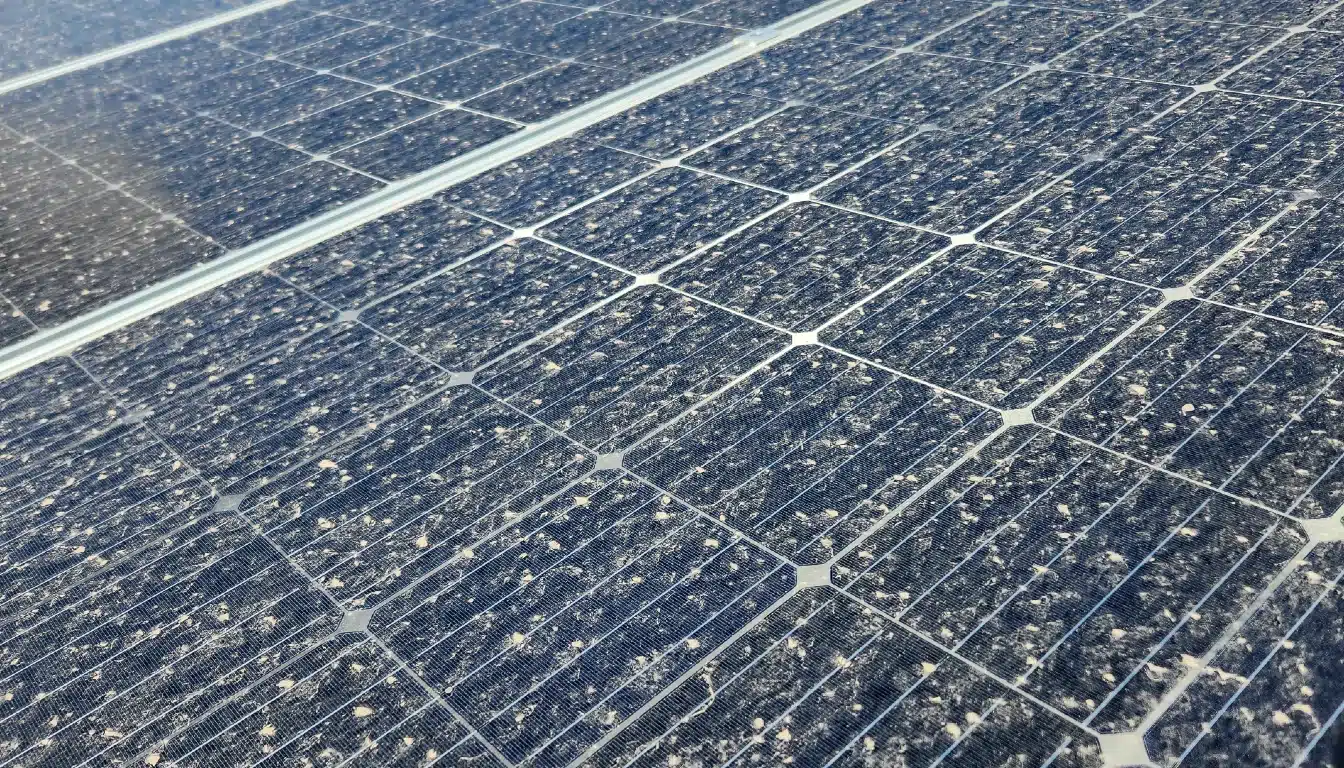
Solar installations worldwide face a persistent maintenance challenge. Dust, sand, and pollution accumulate on panel surfaces and reduce energy output. The global solar sector currently uses more than 12 billion gallons of water annually for cleaning. That figure will rise as installations expand. In arid regions, where solar potential is highest, water scarcity makes conventional high-pressure washing increasingly difficult to justify.
Panel soiling can materially reduce energy yield. For large solar farms operating on thin margins, the financial consequences are real. Cleaning systems that preserve output while reducing water demand carry both environmental and commercial weight.
How the Droplet Mop System Works
The City University of Hong Kong team, led by Professor Steven Wang, worked with collaborators at Imperial College London and the Institute of Process Engineering in Beijing. Their system exploits the physical behaviour of water droplets on impact. When a droplet strikes a panel surface, it spreads outward and then recoils. That spreading and recoil generates hydrodynamic forces. Those forces lift and displace particles from the surface.
The team calls the technique “liquid droplet mops.” It uses roughly a tenth of the water required by standard liquid jet cleaning. The researchers found that cleaning efficiency follows a non-linear pattern. Moderate impact energy produced stronger results than maximum force. In tests using sand particles to replicate desert conditions, optimised droplets removed contaminants with greater consistency than higher-energy approaches.
Professor Wang said the team designed the method to conserve water resources while improving renewable energy deployment. The system can also handle heavier particles, including those with densities several times greater than water. That extends its potential use beyond light surface dust.
What the Research Found
The Nature Sustainability paper reports contaminant removal of up to 99.9 per cent on superhydrophobic-coated solar panels. Water consumption fell by more than 80 per cent compared with conventional methods. Those figures come from laboratory conditions. Independent field validation at scale has yet to be published, and real-world performance may vary depending on panel coating, particle type, and local climate conditions.
The study draws on biomimicry. Butterfly wings and certain plant leaves shed water and debris through surface microstructures. The researchers applied that physical logic to panel cleaning. The droplet system replicates some of those properties without requiring complex mechanical components.
Implications for the Solar Industry
The solar sector is under pressure to reduce its operational footprint. Water use in panel maintenance is one area where that pressure is visible. The International Energy Agency has projected rapid growth in solar capacity through the 2030s, particularly in sun-rich, water-stressed regions across the Middle East, North Africa, and parts of South Asia. Cleaning solutions that demand less water are directly relevant to those deployment environments.
The City University team says the system has particular promise for large solar farms in arid regions. Dust loads are high in those environments, and water access is constrained. A cleaning method that addresses both conditions at once has clear practical value.
The research does not yet include a commercial deployment timeline. The team has demonstrated the method at laboratory scale. Whether the approach can be manufactured and deployed cost-effectively across utility-scale installations remains an open question. Investors and developers considering the technology will want to see field trials and cost assessments before drawing firm conclusions.
Professor Wang and his colleagues have produced a technically credible result. The combination of high removal rates and low water use addresses a genuine operational problem. The path from laboratory finding to widespread adoption is long. The evidence base, at this stage, is promising.