
Researchers have begun installing 100 seismic sensors across Aberdeen to create the first comprehensive subsurface map of the city’s geothermal energy potential, marking the city’s entry into an emerging field of urban low-carbon heating.
The Aberdeen Geothermal Feasibility Pilot deployed the sensors across public and private green spaces from Bridge of Don to Nigg over three days in mid-February 2026. Each node, measuring approximately 10cm by 10cm by 30cm, will record natural and man-made vibrations for up to two months.
The data will generate a three-dimensional map of granite and subsurface structures to a depth of 5km beneath the entire city, revealing optimal locations for geothermal heating infrastructure.
Dr Amy Gilligan, a researcher with the project, said the deployment represents an important phase. “Most people won’t notice the sensors once they are in place but what we learn will help us understand whether geothermal heat could one day provide a clean, local source of heating for homes and public buildings, reducing carbon emissions and support a more sustainable energy future for Aberdeen,” she noted.
The sensors, covered by thin layers of soil, capture seismic noise from waves, wind and traffic. The approach follows similar urban geothermal mapping programmes in Denmark and Switzerland that have demonstrated rapid project timelines.
In Aarhus, Denmark, geothermal developer Innargi completed city-centre seismic surveys in 2023 and began delivering district heat in October 2025, just 26 months after data acquisition ended. The facility now supplies heating to local homes as part of what will become the EU’s largest integrated geothermal district heating system by 2030.
Swiss Geo Energy deployed 21,000 seismic nodes across 100 square kilometres near Lausanne in 2023, completing active source surveying in 11 nights to build detailed structural models of geological formations beneath the surface.
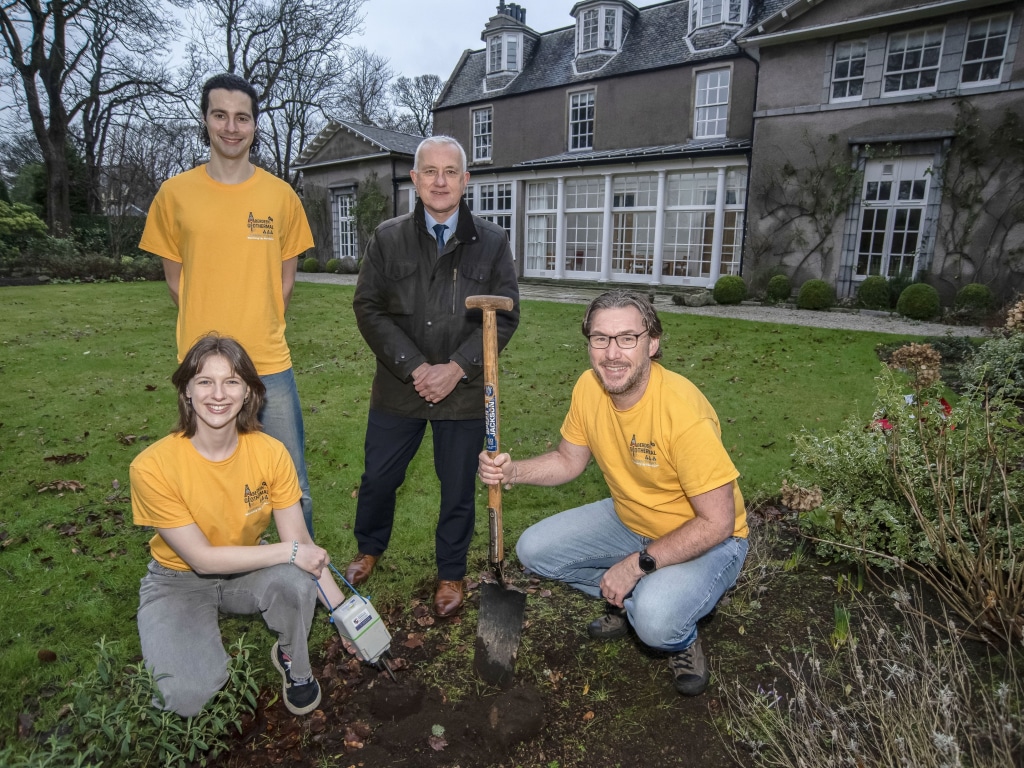
Technician Iona Copley, researcher Tristan Roberts, University of Aberdeen Principal Professor Peter Edwards, and Dr David Cornwell, AGFP co-lead.
The £1 million Aberdeen initiative, funded by UK Research and Innovation through its Natural Environment Research Council, follows earlier desk studies of Aberdeen’s geothermal potential. The University of Aberdeen leads the project alongside NHS Grampian, Aberdeen City Council, Robert Gordon University and the British Geological Survey.
Subject to planning consent, the team will drill an instrumented borehole exceeding 500 metres depth on the King’s College campus in Old Aberdeen. The borehole will provide direct measurements of subsurface temperature, geology and hydrology data.
Professor Clare Bond, project co-lead, said the work provides critical in-field geological data. “This project will be the first to provide the in-field geological data needed to help bring our initiative and others being considered across the city to reality,” she explained.
The borehole findings will be integrated with the city-wide seismic survey to assess how heat flows through rocks beneath Aberdeen. Dr David Cornwell, project co-lead and seismologist, said coupling both datasets will reveal the city’s true geothermal potential.
All collected data will be openly available to help de-risk future geothermal investment and accelerate Aberdeen’s transition to sustainable energy. The information could also predict geothermal potential in other UK locations with similar granite formations.
Professor Louise Heathwaite, Executive Chair of UKRI’s Natural Environment Research Council, described the pilot as potentially transformative. “By combining geoscience research with real-world application, the Aberdeen Geothermal Feasibility Pilot has the potential to transform heating solutions in Aberdeen,” she said.
The project could provide a blueprint for geothermal development in granite formations across the UK, working alongside NERC’s UK Geoenergy Observatories network. NERC has supported the initiative as part of efforts to address fuel poverty whilst advancing net zero ambitions.
The collaboration draws on expertise from the University of Aberdeen’s Estates and Facilities, Geosciences and Engineering Schools, as well as the Centre for Interdisciplinary Research and the Just Transition Lab. Additional partners include Aberdeen Heat and Power, the University of Leeds, TU Delft Netherlands, the National Geothermal Centre and the Net Zero Technology Centre.
If successful, the pilot could extend across Aberdeen for district heating in schools and communities to tackle fuel poverty. Professor John Underhill, Interdisciplinary Director for Energy Transition at the university, noted the initiative demonstrates interdisciplinary working connecting geoscience and engineering.
The UKRI funding enables the first phase of a broader vision to integrate geothermal energy into Aberdeen’s city energy mix. Future phases will focus on reassessing heat poverty information to identify where geothermal can contribute most effectively, whilst empowering communities to lead decisions on heating and energy.
The project emphasises it does not involve fracking, rock fracturing or high-pressure fluid injection. Instead, it uses standard, regulated scientific drilling techniques to measure temperature, geology and groundwater conditions.
The British Geological Survey reported in August 2024 that geothermal energy provides a unique opportunity to deliver low-carbon heating across many UK areas, though the sector faces challenges including regulatory gaps and dispersed geological data.